Creatine: one form, one dose, and a market that mostly agrees
77% of creatine labels declare monohydrate and the most common dose is 5 g, the top of the studied maintenance range. 126 products from 82 brands share one formula. What labels and trials say.
By Alykhan Virani · October 2, 2026 · 7 min read · data from the January 16, 2026 DSLD release
Most supplements we’ve covered on this site have a messy form story: magnesium comes as oxide, citrate, or glycinate; curcumin as plain extract or a phytosome. Creatine is an unusual case. One form has dominated the research for decades, and the label data suggests the market has largely settled on it. That makes it a useful test of how a market behaves when the evidence is relatively clear: how many products still sell something else, what dose they declare, and how many “different” products share a single formula.
The form question: monohydrate versus everything else
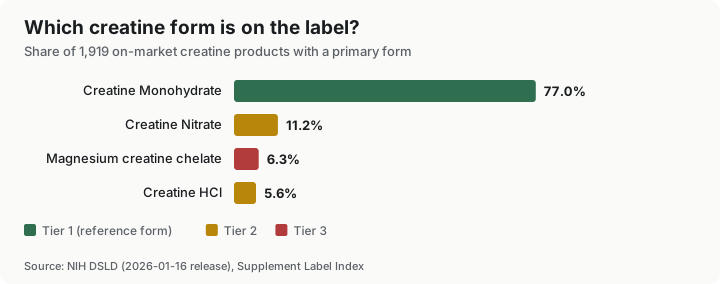
Among the 1,919 on-market creatine products in the NIH Dietary Supplement Label Database (DSLD) with an identifiable primary form, 77.0% declare creatine monohydrate. Creatine nitrate is next at 11.2%, then magnesium creatine chelate (6.3%) and creatine HCl (5.6%). About 88% of all 1,961 creatine products are powders; capsules and tablets together are under 8%.
The International Society of Sports Nutrition’s position stand, a review of the creatine literature, concluded that monohydrate is the most effective ergogenic supplement currently available to athletes for high-intensity exercise capacity and lean mass. The alternatives are generally sold on the promise of better absorption, solubility, or fewer side effects, and the head-to-head trials we could find mostly don’t show an advantage:
- Creatine HCl. A 2025 randomized trial of 31 elite team-sport athletes gave 5 g/day of monohydrate, HCl, or placebo for 8 weeks and found no significant difference between the two creatines on strength, jump, or body composition. (It found no significant between-group differences of any kind, placebo included, so it was small.)
- Buffered creatine. A 2012 trial of 36 resistance-trained participants found a buffered product did not produce greater changes in muscle creatine, body composition, or training adaptations than monohydrate.
- Creatine ethyl ester. A 2009 trial of 30 untrained men found ethyl ester raised serum creatine less than monohydrate and showed no advantage on body composition, strength, or power.
- Creatine nitrate. A 2016 pair of small studies (13 and 48 participants) found 3 g of nitrate was well tolerated and gave similar performance benefits to 3 g of monohydrate, which is a favorable result for nitrate, though not evidence that it outperforms the reference form.
Two cautions. These are small trials, several with authors tied to supplement companies (as is common in this field), and “no demonstrated advantage” isn’t the same as “proven equivalent.” And a 2022 analysis of 175 creatine products on Amazon found 16 forms besides monohydrate, and classified roughly 88% of the alternative-form products as having limited to no evidence for bioavailability, efficacy, and safety; products using only monohydrate averaged $0.12 per gram against $0.26 for products using only other forms. (Its authors also disclose supplement-industry ties.)
One limit of our own data: the form classification recognizes four creatine forms. Ethyl ester and buffered creatine aren’t separately tracked, and a label that says only “creatine” is counted as monohydrate by our reference table. So 77% is best read as “monohydrate or unspecified,” not as a verified count of monohydrate alone.
The 5-gram standard
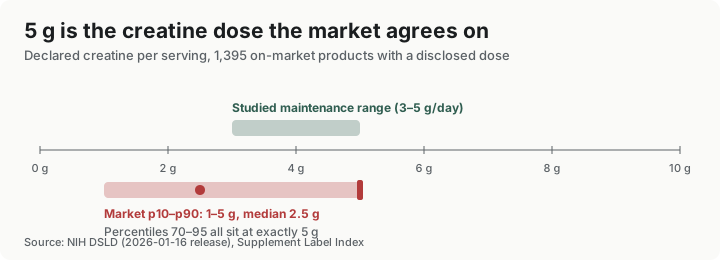
Among the 1,395 creatine products with a disclosed per-serving dose, the median is 2.5 g. But the top of the distribution is strikingly flat: the 70th through 95th percentiles are all exactly 5 g, meaning roughly a quarter of dosed products sit on that single number. The 10th percentile is 1 g, the 90th is 5 g, and the extreme tail reaches 10 g at the 99th percentile and 20 g at the maximum.
That 5 g isn’t arbitrary. The position stand describes the research protocols as roughly 0.3 g/kg a day (about 20 g, taken as four 5 g servings) for 5 to 7 days, followed by 3 to 5 g a day to maintain muscle stores. A classic 1996 study of 31 men found muscle creatine rose about 20% after 6 days at 20 g/day, and that 3 g/day produced a similar rise more slowly, over 28 days. So a 5 g scoop sits at the top of the maintenance range, not above the evidence.
Two things to keep in mind when reading the lower half of the distribution. First, the dose is per serving: a capsule product may list 750 mg per capsule with several capsules a day, so a low declared dose is not necessarily a low daily total. Second, 5.5% of creatine products fall below our fairy-dust threshold of 600 mg, and 26.2% of creatine label appearances don’t state an amount because it sits inside a proprietary blend (a pattern we looked at in the proprietary blends post).
On safety, our reference table lists creatine with no RDA or UL, since the body makes it and it isn’t an essential nutrient. A 2006 risk assessment by authors from the Council for Responsible Nutrition, a supplement-industry trade association, concluded the evidence of safety was strong at up to 5 g/day for chronic use, while noting that data above that for long-term use were insufficient for a confident conclusion. One lab detail often causes worry: supplementation raises serum creatinine, a kidney-function marker. In the 2012 trial above, creatinine rose by 0.1 to 0.2 mg/dL in every group, which the authors described as well within normal values for active people. The NutritionFacts.org video below addresses kidney-safety concerns around lab tests.
126 products, 82 brands, one formula
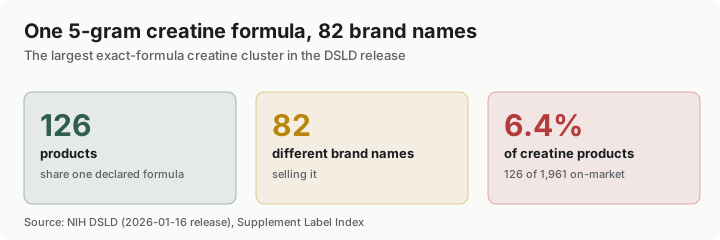
The agreement on dose shows up most clearly in formula twins. The largest exact-formula creatine cluster has 126 products sold under 82 different brand names, all declaring the same compound, form, amount, and serving size: a 5-gram creatine serving (monohydrate, in our classification). That’s 6.4% of all on-market creatine products. The brand list runs from sports-nutrition labels to general wellness names: 1st Phorm, Dymatize, Nutricost, NOW Sports, Optimum Nutrition, Thorne, Bluebonnet, Herbalife Nutrition, and 74 more.
This is what you’d expect for a single-ingredient, well-understood commodity. As we described in the formula twins post, private-label manufacturing lets many brands sell stock formulas under their own names. A matching label doesn’t prove a shared factory or identical purity, but it does mean the declared recipe doesn’t distinguish these products from one another.
Gummies and other formats
Gummies are a minor part of the creatine market in this release: only 2 of 1,961 products are listed as a gummy or jelly. Their declared median dose is 4.5 g against 2.25 g for capsules and tablets, but with a sample of two we wouldn’t read anything into the gap. Creatine gummies have drawn attention in the trade press, though: a July 2025 NutraIngredients report described independent tests in which about half of the gummies tested fell short of their labeled creatine, and quoted a food biochemist on why creatine degrades to creatinine in acidic, hot, or wet gummy manufacturing. We have no test data of our own, and a label can’t tell you what’s in the product. That is a limit of every number on this page. For gummies in general, see our gummy tax post.
What to check before choosing a creatine product
- Read the form line. “Creatine monohydrate” is the form with the deepest evidence base; other forms are usually marketed on claims of better absorption or tolerability that the head-to-head trials we found haven’t supported.
- Check the serving size, not just the milligrams. A “5 g” product and a “750 mg” capsule product can both be fine; what matters is the per-serving amount times how many servings you take.
- Be wary of blends. If creatine appears inside a proprietary blend, the label doesn’t tell you how much there is.
- Price per gram can differ a lot across forms. In the Amazon analysis, products using only non-monohydrate forms cost about twice as much per gram on average.
- Third-party testing is a separate question. A label describes what a company declares, not what a lab measured.
Individual compound pages, including creatine, carry the full dose distribution and form citations, and the Cheap Form Index ranks compounds by how often they’re sold in a low-evidence form.
Sources
- Kreider RB et al. International Society of Sports Nutrition position stand: safety and efficacy of creatine supplementation in exercise, sport, and medicine. J Int Soc Sports Nutr 2017;14:18. PMID 28615996.
- Hultman E et al. Muscle creatine loading in men. J Appl Physiol 1996;81(1):232–237. PMID 8828669.
- Shao A, Hathcock JN. Risk assessment for creatine monohydrate. Regul Toxicol Pharmacol 2006;45(3):242–251 (authors affiliated with the Council for Responsible Nutrition). PMID 16814437.
- Londoño-Velásquez D et al. Creatine monohydrate versus creatine hydrochloride on strength and body composition in elite team-sport athletes: a placebo-controlled randomized clinical trial comparing low dosages. J Int Soc Sports Nutr 2025;22:2533658. PMC12291177.
- Jagim AR et al. A buffered form of creatine does not promote greater changes in muscle creatine content, body composition, or training adaptations than creatine monohydrate. J Int Soc Sports Nutr 2012;9(1):43. PMID 22971354.
- Spillane M et al. The effects of creatine ethyl ester supplementation combined with heavy resistance training on body composition, muscle performance, and serum and muscle creatine levels. J Int Soc Sports Nutr 2009;6:6. PMID 19228401.
- Galvan E et al. Acute and chronic safety and efficacy of dose dependent creatine nitrate supplementation and exercise performance. J Int Soc Sports Nutr 2016;13:12. PMID 27034623.
- Escalante G et al. Analysis of the efficacy, safety, and cost of alternative forms of creatine available for purchase on Amazon.com: are label claims supported by science? Heliyon 2022;8(12):e12113. PMID 36544833.
- Nicolle L. Are creatine gummies a viable delivery format? NutraIngredients, July 8, 2025. nutraingredients.com. Trade-press report of third-party tests; not peer reviewed.
- NutritionFacts.org. Are There Any Side Effects to Taking Creatine?
- NIH Dietary Supplement Label Database, January 16, 2026 release; analysis by Supplement Label Index (methodology).
Follow new findings with the Insights RSS feed — it updates each time the label data refreshes.