The gummy tax: what you give up when a vitamin comes as candy
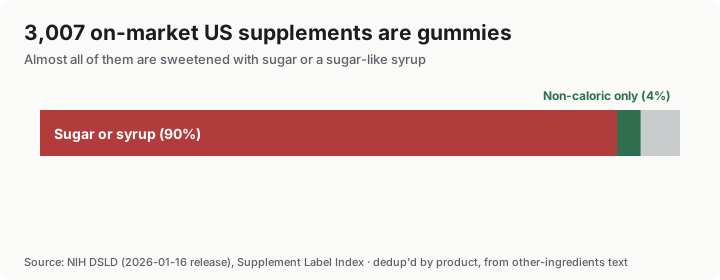
3,007 on-market US supplements are gummies, 90% sweetened with sugar or syrup, and many deliver a fraction of the active ingredient in a capsule. Here's what the trade-off actually looks like.
By Alykhan Virani · September 22, 2026 · 6 min read · data from the January 16, 2026 DSLD release
Gummy supplements exist because pills are unpleasant for a lot of people: hard to swallow, chalky, easy to forget. That’s a real, legitimate reason to prefer them, and gummies are a large and growing part of the market. But turning a tablet into candy has costs that the label doesn’t always spell out clearly. We compared every gummy product in the NIH Dietary Supplement Label Database (DSLD) against its capsule and tablet counterparts to see exactly what changes.
The gummy aisle is mostly sugar
There are 3,007 on-market gummy supplements in the January 2026 DSLD release. Of the 2,823 that name a specific sweetener in their other-ingredients, 2,711, or 90% of all on-market gummies, contain a caloric, sugar-type sweetener such as cane sugar, corn syrup or glucose syrup. Only 112 products, about 4% of the total, use exclusively non-caloric sweeteners like stevia or xylitol.
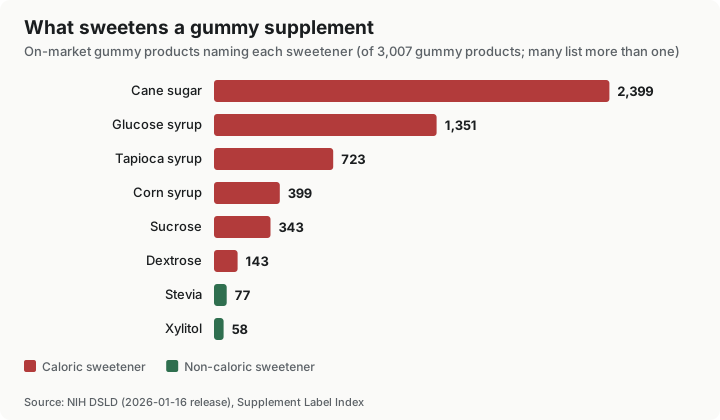
Cane sugar alone appears on 2,399 gummy products, more than three times the next most common sweetener, glucose syrup. This isn’t unique to any one brand or category; it’s close to a default across the format, because sugar and corn syrup are what give a gummy its chewy texture and shelf-stable structure, not just its taste.
How much sugar is actually in a serving
Sugar content varies by product line, but the amounts are not trivial. Among the gummies in our compound-level data, the median declared sugar per serving runs from about 3 grams for many multivitamin and mineral gummies up to about 5 grams for some vitamin B1 and manganese lines.
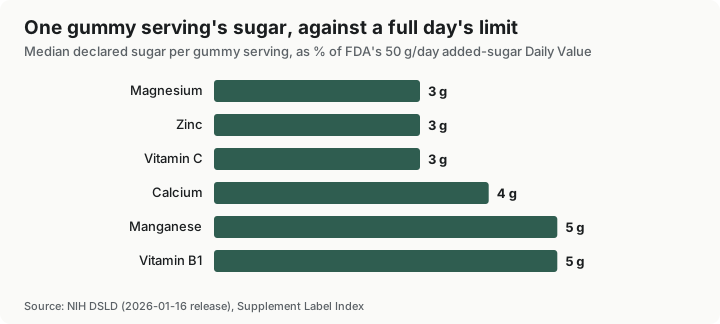
The FDA’s Nutrition Facts label uses 50 grams a day as the Daily Value for added sugars, based on keeping added sugar under 10% of calories in a 2,000-calorie diet. A single gummy serving in the 3-to-5-gram range is 6% to 10% of that entire day’s allowance, before counting anything else you eat or drink. Multivitamin gummies commonly call for two or more gummies per serving, which roughly doubles those figures, and a household that gives a child a gummy multivitamin and an adult a gummy multivitamin and a gummy vitamin D and a gummy magnesium is stacking multiple servings of added sugar without necessarily noticing.
The dose is often smaller too, but not always
Turning an active ingredient into a gummy usually means shrinking the dose. Gelatin and pectin gummies can only hold so much of an ingredient before the texture, taste or stability suffers, and some compounds are unstable or bitter at higher concentrations in a moist matrix. Comparing median doses across the market, gummy versions of several common ingredients deliver a fraction of what a capsule or tablet does.
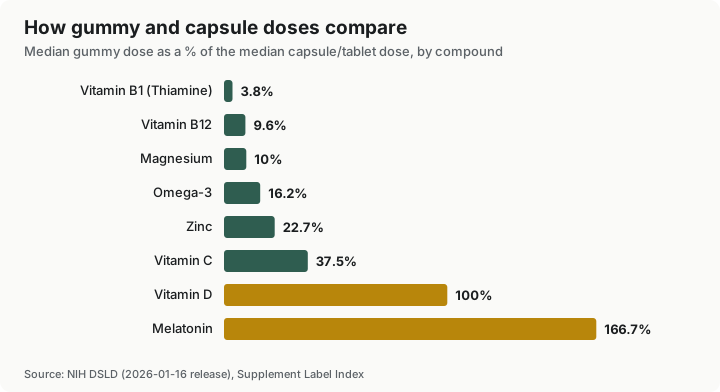
The gap is largest for B vitamins and magnesium: a typical vitamin B1 gummy supplies about 4% of the B1 in a typical capsule, and B12 and magnesium gummies land near 10%. Omega-3 gummies deliver about 16% of a capsule’s dose, largely because fish or algal oil is hard to gel into a stable, chewable candy at high concentrations. Zinc and vitamin C fall in between.
Not every ingredient follows the pattern. Vitamin D gummies match capsule doses almost exactly, and gummy melatonin actually runs higher than capsule melatonin at the median, 5 mg versus 3 mg. Vitamin D is stable and effective in very small mass, and melatonin gummies are typically sold for a specific bedtime dose rather than derived from a repackaged capsule line. The lesson isn’t that gummies are always weaker, but that the format’s limits fall unevenly across ingredients, and you cannot assume a gummy matches its capsule counterpart without checking the label.
Why the format behaves this way
Beyond the sugar itself, gummies have a real stability problem that pills don’t. Moisture, heat and light degrade many vitamins faster in a soft, water-containing gummy matrix than in a dry, compressed tablet. Manufacturers sometimes compensate with an overage, extra active ingredient added at manufacturing to account for expected loss by the labeled expiration date, which cuts the other way: it can mean a fresh gummy briefly contains more than the label states, before declining toward it. Neither the DSLD nor our data captures manufacturing overages, so the doses reported here reflect what’s printed on the label, not necessarily what remains in a bottle six months into its shelf life.
There is also a straightforward manufacturing constraint. A gummy has a fixed size that people are willing to chew, typically 2 to 5 grams, and everything in it, active ingredient, sugars, gelling agent, flavor, color, and acid, has to fit in that volume. A capsule has more room relative to what it needs to hold, because it isn’t limited by palatability the way a candy is.
Overages complicate any single snapshot further. A brand formulating to survive an 18-month shelf life at the label claim has to start higher than that claim on the day of manufacture, because heat and humidity during shipping and storage erode potency over time. Two bottles of what is nominally “the same” gummy, one fresh off the line and one near its expiration date, can differ meaningfully in actual content even though both carry an identical label. Capsule and tablet formats degrade too, but generally more slowly, which is part of why the market default for a shelf-stable, high-precision dose is still a pressed tablet or a filled capsule rather than a gummy.
Kids’ supplements lean on gummies even more
The format is not evenly distributed across the market. Among on-market products marketed specifically to children, 499 of 1,758, or 28.4%, are gummies, versus about 2.5% of on-market supplements overall (3,007 of 121,959 products). That makes sense: gummies are designed to solve the same swallowing problem for children that adults use them for, and the candy format is an easier sell to a child than a tablet. It also means the sugar totals in this post apply disproportionately to the group most often given a supplement daily, sometimes stacked across a multivitamin, a vitamin D and a probiotic gummy at breakfast. Kids’ gummies raise a second issue we haven’t covered here, synthetic dyes, which we look at separately in our Kids’ Supplements report and in a companion post on additives restricted elsewhere but still used in the US.
What to check before choosing a gummy
- Read the per-serving dose, not just the ingredient name, and compare it to a capsule or tablet version of the same product line if one exists.
- Check how many gummies make a serving. Multivitamin gummies frequently require two, which affects both the dose and the sugar total.
- Add up gummies across your household and across ingredients. Several gummy products used together can add up to a meaningful share of a day’s added-sugar budget.
- Look at the sweetener list if added sugar matters to you. A small but real slice of the market, about 4% of gummy products in our data, uses only non-caloric sweeteners.
- Don’t assume the gap runs one direction. As vitamin D and melatonin show, some gummies match or exceed their pill equivalents; check rather than assume.
You can look at gummy sugar and dose comparisons for any of the 38 compounds we track this way in the Gummy Tax report, and see full ingredient dose distributions on each compound page.
Sources
- U.S. Food and Drug Administration. Added Sugars on the Nutrition Facts Label (50 g/day Daily Value, based on a 2,000-calorie diet).
- NIH Dietary Supplement Label Database, January 16, 2026 release; analysis by Supplement Label Index (methodology). Sweetener product counts are deduplicated by product from "other ingredients" text; dose and sugar comparisons come from the site's Gummy Tax metric.
Follow new findings with the Insights RSS feed — it updates each time the label data refreshes.