Formula Twins: the same supplement, sold under 92 different names
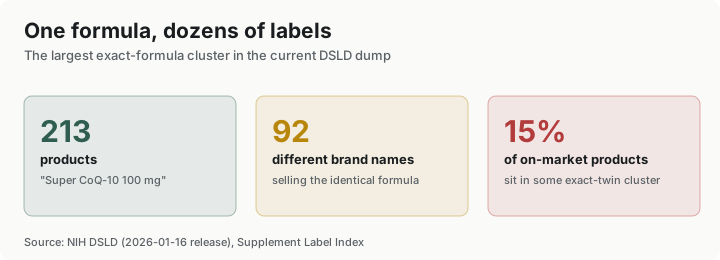
213 products sold under 92 brand names share one identical formula — one of 3,699 such clusters, covering 15.3% of on-market supplements. How private-label manufacturing works.
By Alykhan Virani · September 27, 2026 · 6 min read · data from the January 16, 2026 DSLD release
Walk down a supplement aisle, or scroll a retailer’s vitamin page, and it looks like you’re choosing between dozens of independent products. Often you aren’t. A large share of the US supplement market is the same handful of stock formulas, manufactured once and relabeled many times over. We compared the declared compound, form, amount, and serving size on every on-market label in the NIH Dietary Supplement Label Database (DSLD) to find out exactly how much of the market this covers, and what the biggest examples look like.
One formula, 92 labels
The single largest cluster we found is a CoQ10 softgel: 213 on-market products, sold under 92 different brand names, declare the exact same formula — same compound, same form, same 100 mg amount, same serving size. The brand list includes national retail names like CVS Health and 21st Century alongside dozens of smaller labels: 1st Phorm, Adaptogen Research, BulkSupplements.com, Bronson, California Gold Nutrition, and on from there. To be clear about what “exact” means here: every one of those 213 listings shares an identical compound/form/amount/serving-size fingerprint. Nothing about that fingerprint is unique to any one of the 92 brands selling it.
This isn’t a one-off. It’s the top of a very long list.
This happens at scale, not just once
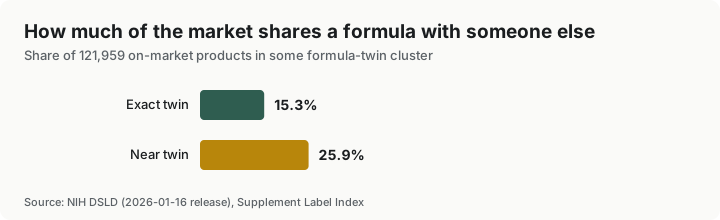
Across the whole catalog, we found 3,699 distinct clusters of products sharing an identical formula across at least two different brands. Altogether, those clusters account for 18,643 products — 15.3% of everything currently on-market. Loosen the definition to a “near-twin” (same compound and form, ignoring the exact declared amount, since some brands round or scale a shared formula slightly), and the share climbs to 25.9% of the market.
The pattern spans very different corners of the market, not just one product category. Here are the eight largest exact-formula clusters we found:
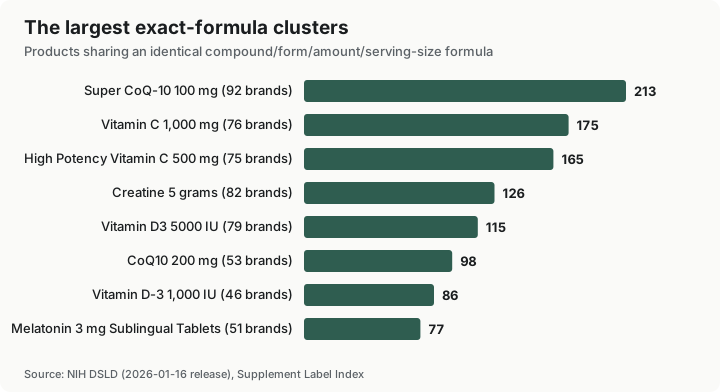
A basic 1,000 mg vitamin C tablet, a 5-gram creatine monohydrate scoop, a 5,000 IU vitamin D3 softgel, a 3 mg melatonin sublingual — every one of these is sold under dozens of separate brand names with nothing separating them on the label except who printed it. The 1,000 mg vitamin C cluster alone spans 76 brands, from small specialty labels up to Amazon’s own house brand, Amazon Elements. The 500 mg “high potency” version, a separate 165-product cluster, includes Bronson, Carlson, Country Life, and Bodybuilding.com’s own house label. The 5-gram creatine cluster, 82 brands deep, runs from general-nutrition names like 1st Phorm down to sports-specific labels like Anabolic Warfare and AST Sports Science — different marketing entirely, identical declared formula.
How this happens: private label and contract manufacturing
None of this is secret, and none of it is against any rule. It’s simply how a large part of the supplement industry works. A relatively small number of contract manufacturers produce large batches of common, well-understood formulas — a plain vitamin C tablet, a standard multivitamin, a basic magnesium capsule — and sell that same batch, unbranded, to any retailer or brand owner who wants to put their own label on it. This is usually called private-label or “OEM” manufacturing: the brand doesn’t design the formula, doesn’t run the factory, and in many cases doesn’t touch the product until it’s already made. The alternative, contract manufacturing a brand’s own custom formulation from scratch, costs more and takes longer, which is exactly why the private-label route is so common for simple, commodity ingredients where there’s little room to differentiate the formula anyway.
That’s also why the pattern concentrates where it does. Nobody is running a proprietary process to make a 1,000 mg vitamin C tablet interesting; the chemistry is settled, the manufacturing is routine, and dozens of brands are happy to buy the same stock batch rather than pay to develop their own. Compounds with more genuine formulation variation, unusual forms, proprietary blends, novel delivery methods, show up far less often in these clusters, because there’s an actual reason for two products to differ.
Why “near-twin” is a separate, looser category
We split this into two passes for a reason. The exact-twin match requires every compound, every declared form, every rounded elemental amount, and the serving size to line up precisely, which is a genuinely strict bar: a product with 1,000 mg of vitamin C and one with 1,000.5 mg (a real, if trivial, rounding difference between manufacturers) would not match. The near-twin pass drops the amount requirement and matches on compound and form alone, catching brands that clearly license the same base recipe but scale it slightly, split a serving differently, or round to a different convention. Near-twin is the more honest picture of how much of the market runs on a shared handful of recipes; exact-twin is the more conservative, defensible claim that two products are, as declared, identical. We report both rather than picking the more dramatic-sounding one.
This sits alongside two things we’ve already looked at on this site: the Cheap Form Index, which tracks how often a compound is sold in its least-absorbed form, and proprietary blends, which hide a formula’s actual composition entirely. Formula twins are a different kind of pattern from either: not a hidden dose, not a weak form, just the same fully-disclosed recipe sold under more names than most shoppers would guess.
What an identical formula does and doesn’t tell you
A shared formula is not proof of a shared factory, and it’s definitely not proof of identical quality. Two products with the same declared compound, form, and amount can still differ in excipients, in coating, in how fresh the batch is by the time it reaches a shelf, and in whether the manufacturer runs the quality-control testing it claims to. DSLD is a label database: it tells you what’s declared, not how it was made or how well the plant that made it is run. A formula-twin match is evidence that two labels describe the same recipe on paper, nothing more and nothing less.
It’s also not evidence of a defect in either product. Buying the version of a commodity formula that a brand didn’t have to reinvent isn’t a downgrade; it’s how a lot of ordinary manufacturing works, in supplements and well beyond them. The useful takeaway isn’t “avoid these,” it’s narrower: when a formula is this common, the brand name on the front of the bottle is telling you very little about what’s actually inside. For a simple, single-ingredient product especially, the manufacturer, the price, and your own trust in the retailer are doing more of the real work than the label’s compound/form/amount ever will.
What to check before assuming two products differ
- Compare the actual ingredient panel, not the front label. Two products with different names, colors, and marketing copy can carry the byte-for-byte identical Supplement Facts panel.
- A shared formula narrows what’s left to compare. Once the compound, form, and amount match, what’s actually left to differentiate two products is price, freshness, and manufacturer reputation, not the ingredients themselves.
- This is most common for simple, single-ingredient formulas. A plain vitamin, mineral, or single-compound product is far more likely to be a formula twin than a multi-ingredient blend with a genuinely distinct recipe.
- A twin match isn’t a warning sign. It just means you’re looking at commodity manufacturing, which is a normal and common part of the industry, not a red flag on its own.
You can look up any product’s own formula-twin cluster, if it has one, on its product page, and see the full ranking of clusters on the Formula Twins report.
Sources
- NIH Dietary Supplement Label Database, January 16, 2026 release; analysis by Supplement Label Index (methodology). A formula-twin cluster is the sorted set of (compound, form, rounded elemental amount) tuples on a label plus its serving size, matched exactly (or, for near-twins, compound and form only) across at least two distinct brands.
- KHOU 11. VERIFY: Are name-brand vitamins better than generic?
Follow new findings with the Insights RSS feed — it updates each time the label data refreshes.