Proprietary blends: the supplement label line that hides the dose
More than one in four US supplement labels lists a proprietary blend. Here is what the rules require, what they let brands keep secret, and how to read one.
September 20, 2026 · 6 min read · data from the January 16, 2026 DSLD release
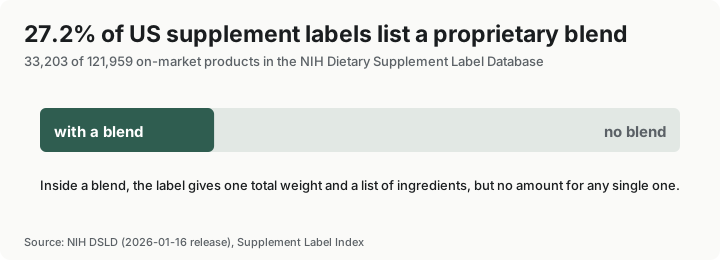
Somewhere on the back of the bottle, between the vitamins and the fine print, there is often a line that reads something like “Energy Matrix” or “Focus Complex” followed by a single weight and a list of ingredients. That is a proprietary blend. It is legal, it is common, and it is the one place on a Supplement Facts panel where the label stops telling you how much of each ingredient you are getting.
We counted how often it happens across every product in the NIH Dietary Supplement Label Database (DSLD). In the January 2026 release, 27.2% of on-market products, 33,203 of 121,959, list at least one proprietary blend.
What the rules actually require
The Food and Drug Administration’s labeling rules (21 CFR 101.36) give blends specific treatment. According to FDA’s labeling guide, a blend must be identified with the term “Proprietary Blend” or an appropriately descriptive or fanciful name, and the label must list the total weight of the “other dietary ingredients” in the blend on the same line. The ingredients inside must be indented underneath and listed in descending order of predominance by weight.
What is not required is the amount of each ingredient. That is the trade-off the rule creates: a brand can keep its exact formula private, and you can see the total and the order but not the individual doses.
There is an important exception, and it explains a pattern we see in the data. Ingredients that have an official Daily Value, such as vitamins and minerals, must be listed separately with their own weights. Blends are therefore mostly a home for botanicals, amino acids and other ingredients without a Daily Value.
Where blends live
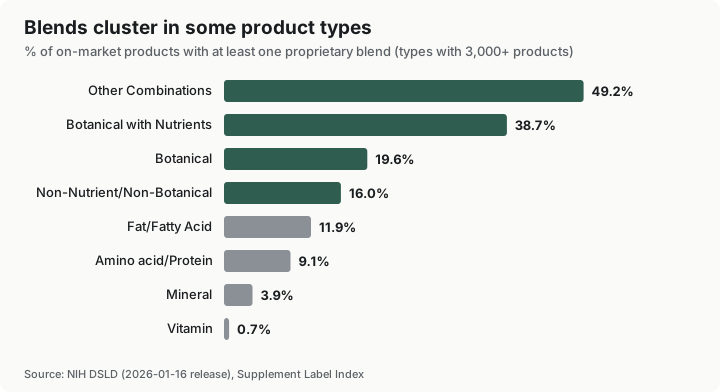
The split by product type follows that rule closely. Nearly half of “other combination” products (49.2%) and almost four in ten botanical-with-nutrient products (38.7%) list a blend. Among plain vitamins it is 0.7%, among single vitamin-and-mineral products 0.2% and among multivitamins 2.4%.
If you buy a vitamin D tablet or an iron capsule, a blend is very unlikely. If you buy a pre-workout, a “focus” formula or a greens powder, it is common.
Blends are also not going away. The share of newly entered labels with a blend was 36.7% in 2011, settled between roughly 24% and 26% from 2020 to 2024, and rose to 28.1% for products entered in 2025. (The 2011 figure rests on only 1,162 products, so treat it with caution.)
Which ingredients hide
Because blends are made of ingredients without Daily Values, the same handful of compounds keeps showing up inside them. We looked at every time one of our tracked ingredients appears on a label and asked how often its amount is undisclosed because it sits in a blend.
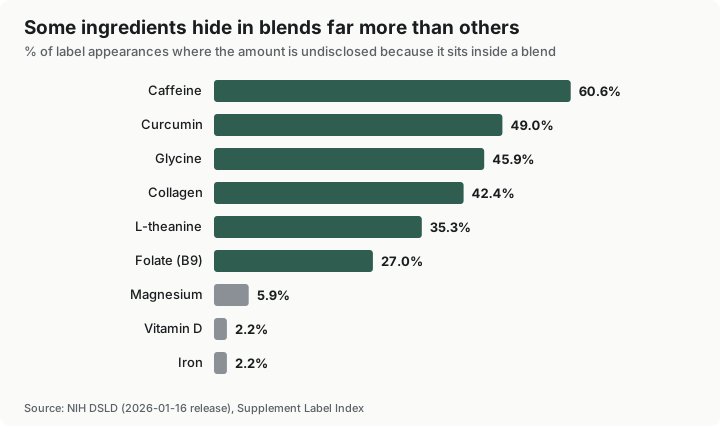
Caffeine leads: when caffeine appears on a US supplement label, its amount is undisclosed 60.6% of the time. Curcumin (49.0%), glycine (45.9%) and collagen (42.4%) are close behind. Vitamin D and iron, which have Daily Values, are hidden only 2.2% of the time.
That matters most for ingredients where dose is the whole point. If a study found an effect at a certain amount of curcumin or L-theanine, a label that hides the amount cannot tell you whether the product contains anything close to it, and for caffeine, not knowing your total intake is a practical safety issue.
What the order does, and does not, tell you
Because ingredients inside a blend are listed from heaviest to lightest, you can infer a little. Suppose a 300 mg blend lists five ingredients. The first must weigh at least 60 mg, because it is the heaviest and the average is 300 divided by 5. The last cannot exceed 60 mg, because it is the lightest. Everything in the middle can be anything from a trace up to the amount of the ingredient above it.
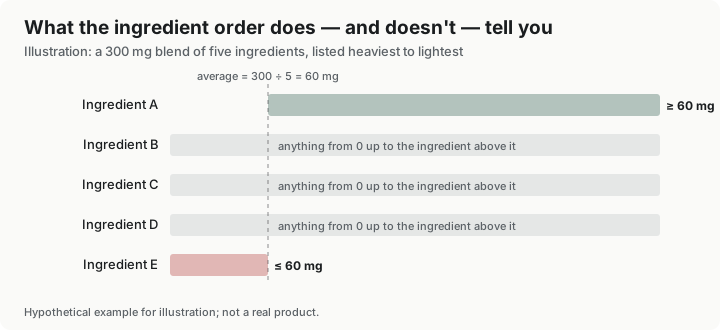
This gives you two useful tools. First, compare the blend total with the amount used in research. If the studied dose of an ingredient is 300 mg and the whole blend weighs 250 mg, the product cannot contain it at that dose. Second, look at the ingredient count: the more ingredients share a fixed total, the smaller the average serving of each.
A worked example: the caffeine problem
Take a hypothetical pre-workout whose label lists a “Focus Blend” of 900 mg containing six ingredients, with caffeine somewhere in the list. The label does not say how much caffeine that is, but the ordering rule sets limits. If caffeine is listed first, it must be at least 150 mg, one sixth of the total. If it is listed last, it can be no more than 150 mg. If it is somewhere in the middle, the label gives you no useful bound at all.
That range matters because caffeine is one of the few ingredients with a widely cited daily reference point. The FDA says about 400 mg a day, roughly two to three 12-ounce cups of coffee, is an amount not generally associated with negative effects for most healthy adults. A shopper who also drinks coffee or an energy drink cannot tell from the blend line how close a single scoop brings them to that figure. Some products print the caffeine amount separately, outside the blend, and when they do you can simply read it.
The case for blends
Brands and their trade groups make several arguments for keeping formulas private. Recipes take time and money to develop, and they say competitors can copy a fully disclosed formula. Some products use branded ingredient complexes bought from suppliers, and brands say the exact make-up of those is not theirs to publish. And a blend at least has to state its total weight and name every ingredient in order, which tells you more than an ingredient list with no weights at all.
Two videos give you both perspectives. The first is an industry perspective on proprietary blends from the founder of a supplement company, so keep in mind that the presenter sells supplements. The second is a critical look at blends from a supplement price-comparison and review site.
Blends are not the “Other ingredients” line
It is easy to confuse a proprietary blend with the “Other ingredients” list at the bottom of a label. They are different things. A blend sits inside the Supplement Facts panel and groups active ingredients whose individual amounts are withheld. The “Other ingredients” line lists the fillers, binders, colors and coatings that make the product manufacturable, which carry no amounts on any label. We track those separately on our excipients pages.
How we handle blends in our own numbers
Blends also pose a problem for analysis, and we want to be clear about how we deal with it. In the NIH database, the ingredients nested inside a blend almost always report their amount as “not present,” meaning no individual amount was disclosed. We record those as undisclosed rather than estimating them, because a guess would look like data. That is why our dose statistics for a compound such as curcumin or glycine cover only the products that declare an amount, and why we report the share of appearances hidden in blends as its own figure. Our methodology page describes the full set of conventions.
How to read a blend on your next label
- Find the total weight and divide it by the number of ingredients. That is roughly the average dose of each, and the last ingredient is at or below it.
- Compare with the studied dose. If you are buying for one ingredient, check the amount used in research against the whole blend’s weight.
- Look for the ingredient you care about. The first ones listed are the heaviest; one listed near the end of a long blend is probably present in a small amount.
- Check stimulants separately. If caffeine sits in a blend, the label may not tell you how much you are consuming, so consider the product’s total and your own tolerance.
- Prefer labels that list separate amounts when dose matters to you. A blend is not a red flag by itself, but it does mean you are taking the brand’s word for what is in it.
You can see how blends vary by product type and ingredient on our Proprietary Blends report, and check how much of a specific ingredient hides in blends on its compound page, for example caffeine or curcumin.
Sources
- U.S. Food and Drug Administration. Dietary Supplement Labeling Guide: Chapter IV. Nutrition Labeling (proprietary blends; 21 CFR 101.36(b)(2) and (c)).
- U.S. Food and Drug Administration. Spilling the Beans: How Much Caffeine Is Too Much? (400 mg a day for most healthy adults).
- NIH Dietary Supplement Label Database, January 16, 2026 release; analysis by Supplement Label Index (methodology). Share of ingredient appearances hidden in a blend counts each matched label row for on-market products.
Follow new findings with the Insights RSS feed — it updates each time the label data refreshes.