Magnesium oxide, citrate or glycinate? What the form on your label tells you
Nearly half of magnesium supplements never name their form, and 1,000 mg of the compound is not 1,000 mg of magnesium. Here is how to read the label.
September 20, 2026 · 6 min read · data from the January 16, 2026 DSLD release
Pick up any magnesium bottle and you will find a number in milligrams, a brand name and, if you are lucky, a small parenthetical such as “(as magnesium citrate)”. That parenthetical is doing a lot of work. It tells you which chemical the magnesium is attached to, and that choice affects how much actual magnesium is in the capsule, how well your body absorbs it and how your stomach reacts.
We analyzed every magnesium product in the NIH Dietary Supplement Label Database (DSLD): 14,666 on-market products in the January 2026 release. Here is what the labels say, what the research can and cannot tell you, and how to read one yourself.
The first surprise: many labels do not say
Of the 11,755 products where we could identify a primary magnesium form, 48.4% do not state a form at all. They list “Magnesium” and an amount, with no salt named. Another 27.0% use magnesium oxide, 13.0% citrate, 4.9% glycinate, 4.3% aspartate and 2.4% an “amino acid chelate.”
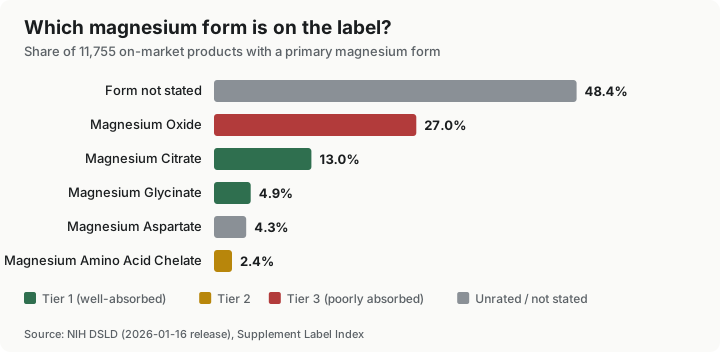
Among the 6,062 products that name a specific form, oxide accounts for 52.4%, citrate for 25.3% and glycinate for 9.5%. Oxide is the most common form on shelves, and, as we will see, it is also the one the research rates lowest for absorption.
Compound weight is not magnesium weight
Magnesium never travels alone in a supplement. It is bound to something: oxygen, citric acid, the amino acid glycine. That partner adds weight, so a milligram of compound contains well under a milligram of magnesium.
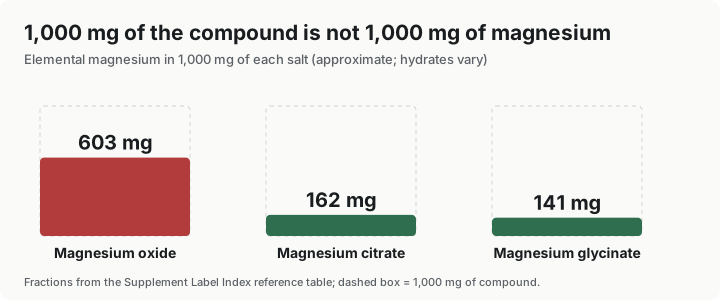
The share of magnesium by weight varies a lot. Using the fractions in our reference table, 1,000 mg of magnesium oxide contains about 603 mg of elemental magnesium, while 1,000 mg of magnesium citrate contains about 162 mg and 1,000 mg of glycinate about 141 mg. Hydrated versions differ, so treat these as approximate.
Labels usually handle this for you. A line reading “Magnesium (as magnesium citrate) 100 mg” normally declares the elemental magnesium, with the source in parentheses. But some products name the salt itself as the ingredient, such as “Magnesium Citrate 500 mg,” and in that case the number is the weight of the whole compound. Our methodology page explains how we convert those rows so products can be compared on elemental magnesium.
The practical lesson: compare elemental milligrams. A 500 mg tablet of magnesium citrate and a 500 mg tablet of magnesium oxide are very different products, and a bigger number on the front of the bottle does not mean more magnesium.
What the research says about absorption
Absorption studies are the reason our reference table puts oxide in its lowest tier and citrate in its highest.
A 1990 study by Lindberg and colleagues in the Journal of the American College of Nutrition compared magnesium citrate with magnesium oxide in healthy volunteers and found citrate was more bioavailable, judged by how much magnesium appeared in urine. Part of the explanation is chemistry: magnesium oxide is barely soluble in water and only partly soluble in stomach acid, while citrate dissolves readily.
A 2003 randomized, double-blind trial by Walker and colleagues in Magnesium Research compared oxide, citrate and an amino acid chelate over several weeks. Citrate produced the strongest rise in the magnesium measures the researchers tracked, and the chelate came in below it.
Two caveats matter here. First, these were small studies that used blood, saliva or urine levels as stand-ins for absorption, not outcomes such as sleep, muscle cramps or blood pressure. Second, glycinate is widely marketed as gentle and well absorbed, but head-to-head human data for it are thinner than the citrate-versus-oxide evidence. Its top tier in our table reflects limited evidence and its favorable reputation, so we would not describe it as proven superior.
What “chelate” does and doesn’t mean
Labels also use words that sound more scientific than they are. A chelate is a mineral bound to an organic molecule such as an amino acid, and “magnesium bisglycinate” describes magnesium bound to two glycine molecules, which is reasonably specific. “Amino acid chelate,” on the other hand, is a category rather than a single compound: it can describe magnesium attached to a mix of amino acids, and the exact makeup varies by manufacturer. That is one reason our table rates it a tier below citrate on the strength of the one trial that tested it, and why “chelated” on a front label is a description, not a guarantee of better absorption.
Absorption also is not everything. Magnesium that stays in the gut draws water into the bowel, which is why magnesium oxide and citrate are both used as laxatives at higher doses, and why the upper limit for supplemental magnesium, as reported by the National Institutes of Health, is based on diarrhea.
Form and dose are separate questions
If oxide is absorbed less well, you might expect oxide products to compensate with bigger doses. They do not. Across products that name their form, the median declared dose is 100 mg of elemental magnesium for oxide, 75 mg for citrate and 100 mg for glycinate. The forms do not differ much in how much magnesium they contain per serving; they differ in what is attached to it.
Dose is where the label gets more interesting. Across the 14,120 magnesium products with a declared amount, the median product supplies 80 mg per serving. Nine in ten supply 320 mg or less.
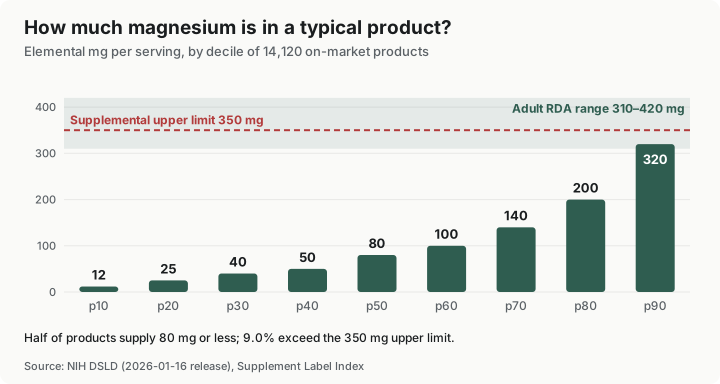
Two reference points frame these numbers. The adult Recommended Dietary Allowance is 310 to 420 mg a day depending on age and sex, and it covers magnesium from food and supplements together. The tolerable upper intake level for magnesium from supplements and medications alone is 350 mg a day for adults.
Against those benchmarks, 94.7% of products supply less than 420 mg per serving, which makes sense: supplements are meant to top up a diet, not replace it. At the other end, 9.0% declare a serving above the 350 mg supplemental upper limit. That is not automatically unsafe, since the limit is a threshold for adverse effects in the general population and people vary, but it is a reason to read the serving size closely. Many labels define a serving as more than one capsule, and the declared dose is per serving, not per capsule.
What if the form is not named?
A label that says only “Magnesium 100 mg” is not necessarily poor quality. Some manufacturers simply leave the parenthetical off. But without a named form you cannot check the absorption research, and you cannot verify the elemental conversion yourself. If magnesium is the reason you are buying the product, a label that names its form gives you more to go on, and a manufacturer’s website or a quick email can often fill in the gap.
A short checklist for your next magnesium label
- Find the elemental amount. Look for “Magnesium (as …)” and check whether the milligrams describe the mineral or the whole compound.
- Look for the form. If the label names none, you cannot tell how well it will be absorbed. Our data suggest that is the case for close to half of products.
- Check the serving size. Multiply by how many servings you would actually take in a day.
- Compare against the 350 mg supplemental limit, not just the RDA, and remember magnesium from food counts toward the RDA but not toward that limit.
- Ask a professional if you have kidney problems or take medication. The NIH notes that impaired kidney function raises the risk of magnesium build-up, and magnesium can interact with some antibiotics and other drugs.
You can explore the underlying numbers on our magnesium page, compare forms head to head on oxide versus citrate, or see how often each compound is sold in its lowest-absorption form in the Cheap Form Index. Products above their upper limit are tracked in Upper Limit Watch.
Sources
- National Institutes of Health, Office of Dietary Supplements. Magnesium: Fact Sheet for Health Professionals (RDA, upper limit, adverse effects).
- Lindberg JS et al. Magnesium bioavailability from magnesium citrate and magnesium oxide. J Am Coll Nutr 1990;9(1):48–55. PMID 2407766.
- Walker AF et al. Mg citrate found more bioavailable than other Mg preparations in a randomised, double-blind study. Magnes Res 2003;16(3):183–191. PMID 14596323.
- NIH Dietary Supplement Label Database, January 16, 2026 release; analysis by Supplement Label Index (methodology).
Follow new findings with the Insights RSS feed — it updates each time the label data refreshes.