Nearly 1 in 3 niacin products cross the adult upper limit — and the UL doesn't distinguish why
29.5% of on-market niacin products declare a dose above the adult tolerable upper intake level, by far the highest share of any compound we track this way. The UL covers two very different forms.
By Alykhan Virani · September 27, 2026 · 5 min read · data from the January 16, 2026 DSLD release
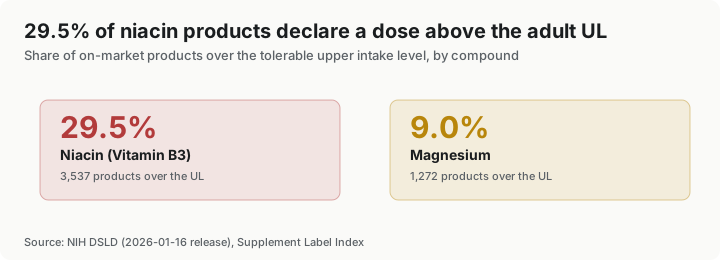
Most nutrients on a supplement label sit comfortably under their official upper intake level. Niacin doesn’t. We checked every on-market product’s declared dose against the seven compounds with an established adult tolerable upper intake level (UL) in the NIH Dietary Supplement Label Database (DSLD), and niacin came out far ahead of everything else, by a wide margin that the UL itself doesn’t fully explain.
The gap between niacin and everything else
29.5% of on-market niacin products, 3,537 of the 11,983 we could evaluate, declare a per-serving dose above the adult UL of 35 mg NE. The next-highest compound we track this way is magnesium at 9.0%; after that, every other compound falls under 3%.
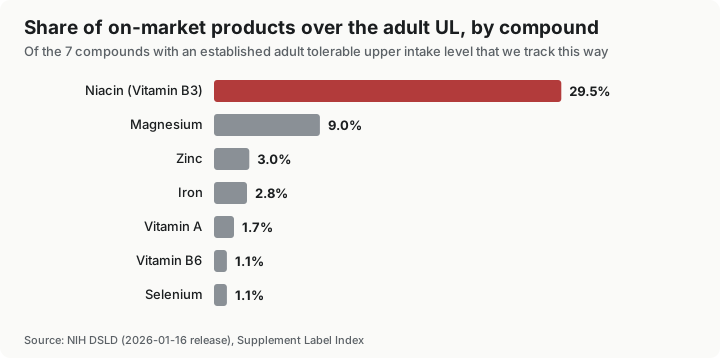
That’s a real, striking gap. It’s also, on its own, a somewhat misleading one, because niacin’s UL was never built to describe a single risk shared equally by every product carrying that name.
One UL, two different compounds
“Niacin” on a label can mean either of two chemically distinct forms: nicotinic acid or niacinamide (also called nicotinamide). Both correct a niacin deficiency equally well, since the body uses either to make NAD+, the molecule niacin ultimately exists to supply. But only nicotinic acid causes the “niacin flush,” the reddening, warmth, and prickling in the face and chest that shows up at higher doses. Niacinamide does not share that vasodilating effect, and in practice is documented to be far better tolerated at high doses. Nicotinic acid is also the form with real, separate lipid-modifying pharmacology, the reason it was the first cholesterol-lowering drug on the market in the 1950s; niacinamide doesn’t do that.
The official Institute of Medicine 1998 dietary reference intake report, which set the 35 mg UL, applies it to both forms, using flushing as the “critical adverse effect” that determines the threshold. That’s a genuinely conservative, population-level policy choice: rather than set two ULs and risk someone confusing the labels, the report picked one number, based on the more flushing-prone form, and applied it across the board. The result is a UL that is almost certainly stricter than niacinamide alone would need on its own physiological grounds, even though it’s the official standard for both.
DSLD’s declared amounts don’t let us cleanly separate every product’s nicotinic-acid-only dose from a niacinamide-only dose across the whole 3,537-product group in this analysis, so we’re reporting the UL exactly the way the official reference does: as one number covering both forms. What that means in practice is that this 29.5% figure almost certainly overstates how often someone using a niacin supplement will actually experience the flush the UL was built around, because a real share of those products are the niacinamide form the flush doesn’t apply to.
Why niacin still stands out even accounting for this
None of that makes niacin’s numbers uninteresting, it makes them a genuinely different kind of finding than “3,537 products are unsafe.” A few things are true at once. First, the flush itself is well-documented as harmless and temporary, not dangerous, even for the nicotinic-acid products where it does apply, so crossing this particular UL is a comfort threshold for a lot of products, not a toxicity one. Second, the UL exists because nicotinic acid, at high enough doses over long enough periods, has been linked to more serious effects than flushing, including liver enzyme changes, which is why 35 mg is the ceiling and not just “however much causes visible redness.” Third, and this is the part actually worth knowing before buying: a shopper reading “Niacin 500 mg” on a label has no way to tell from that alone whether they’re buying the flush-prone form, the well-tolerated form, or a blend of both, unless the label specifically names nicotinic acid or niacinamide rather than just “niacin.”
That’s the same gap we’ve written about before with other compounds, magnesium’s citrate-vs-oxide split, curcumin’s plain-vs-phytosome split: the compound name on the front of the label is doing far less work than shoppers assume, and the specific form is where the real information is. Niacin is a sharper version of that same problem, because the two forms aren’t just differently absorbed, they have meaningfully different real-world effects at the doses people actually take.
Why the rest of the list looks so different
Magnesium, at 9.0%, is the only other compound anywhere close to double digits, and we’ve written about why separately: a meaningful share of magnesium products use high doses of the poorly-absorbed oxide form, and the UL here specifically covers supplemental magnesium (not magnesium from food), based on a much more common, milder effect (diarrhea) than niacin’s flush. See our earlier post on magnesium’s form problem for more.
Everything else, zinc, iron, vitamin A, vitamin B6, selenium, sits under 3%. That’s not because those compounds are less popular; several of them (zinc, iron) appear on more on-market products than niacin does. It’s that their ULs sit much further above their typical declared doses, so a product would have to be formulated unusually aggressively to cross the line at all. Niacin and magnesium are the outliers precisely because ordinary, common product formulations for those two compounds already sit close enough to their respective ULs that a routine “high potency” version tips over.
What to check before assuming a “high dose” niacin product is a problem
- Check whether the label says nicotinic acid or niacinamide, not just “niacin.” That single word tells you whether flushing is even a realistic possibility.
- A dose above 35 mg NE isn’t automatically dangerous. ULs are conservative population thresholds, not a bright line between safe and unsafe for every individual; the CaveatBlock on our own reports says the same about every compound we track this way.
- Flushing is uncomfortable, not typically harmful, and usually fades with continued use. It’s the most common reason people notice they’ve crossed this particular threshold, not evidence of a more serious effect.
- Higher-dose nicotinic acid products exist deliberately, often marketed for cholesterol support at doses well above what a basic multivitamin would use, which is part of why niacin’s distribution skews so much higher than compounds like selenium or vitamin B6.
See the full compound-by-compound breakdown, including example over-UL products for all seven compounds we track this way, on the Upper Limit Watch report.
Sources
- Institute of Medicine (US) Standing Committee on the Scientific Evaluation of Dietary Reference Intakes. Dietary Reference Intakes for Thiamin, Riboflavin, Niacin, Vitamin B6, Folate, Vitamin B12, Pantothenic Acid, Biotin, and Choline (1998) — niacin UL of 35 mg NE, based on flushing, applied to both nicotinic acid and nicotinamide. NIH ODS Niacin fact sheet.
- NutritionFacts.org. Risks and Benefits of Nicotinic Acid (NA), a NAD+ Booster.
- NIH Dietary Supplement Label Database, January 16, 2026 release; analysis by Supplement Label Index (methodology; full citations on the Upper Limit Watch report).
Follow new findings with the Insights RSS feed — it updates each time the label data refreshes.