Fish oil labels: "total omega-3" is not the same as EPA plus DHA
More than half of omega-3 labels lead with a total line, and the median declares 501 mg per serving. What labels say, what trials tested, and why EPA plus DHA is the number to find.
By Alykhan Virani · October 2, 2026 · 6 min read · data from the January 16, 2026 DSLD release
A fish oil bottle usually has two numbers on it. The front says something like “1,000 mg fish oil” or “1,200 mg omega-3.” The Supplement Facts panel, if you turn the bottle around, breaks that into EPA, DHA, and sometimes a “total omega-3” line. They are not the same number, and the studies of omega-3 fatty acids are written in terms of EPA and DHA, not the weight of the oil. We looked at every on-market omega-3 product in the NIH Dietary Supplement Label Database (DSLD) to see how labels declare them: 4,572 products in the January 2026 release.
Which number is on the label
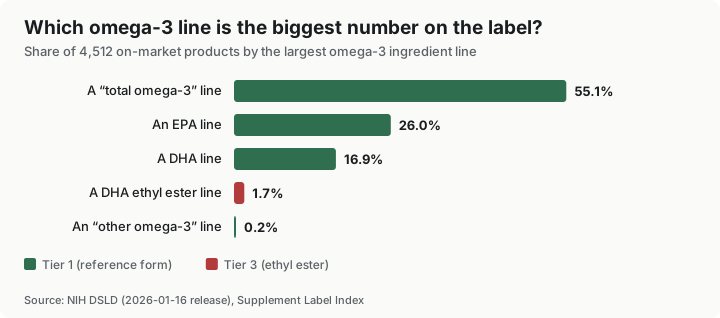
For each product we look at the omega-3 ingredient lines and note which one carries the largest amount. For 55.1% of products it is a “total omega-3” line. For 26.0% it is an EPA line, and for 16.9% a DHA line. A small remainder, 1.7%, is a DHA ethyl ester line (more on that below), and 0.2% an “other omega-3” line. A label that lists only separate EPA and DHA lines counts toward whichever is larger.
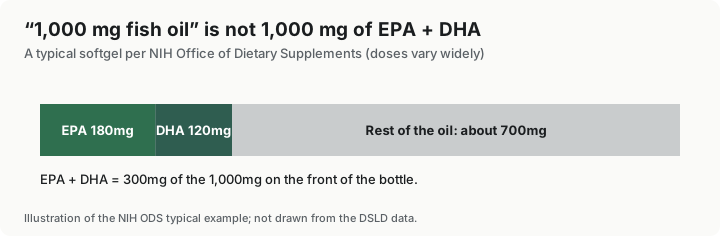
A total line can include omega-3s other than EPA and DHA, such as the plant-derived ALA, so it is at best an upper bound on the EPA plus DHA you would actually get. The NIH Office of Dietary Supplements gives a sense of the gap: a typical fish oil supplement provides about 1,000 mg of fish oil containing 180 mg EPA and 120 mg DHA, though it notes that doses vary widely.
One caution about our own reading. Because DSLD records what each label declares, a product that shows only a front-of-bottle “fish oil” weight, with no omega-3 line in its panel, may be missing from these numbers. And our reference table gives a bare “total omega-3” line the benchmark tier by default, since the label does not say which chemical form it is. That is an assumption, not something the label tells you.
How much omega-3 is declared
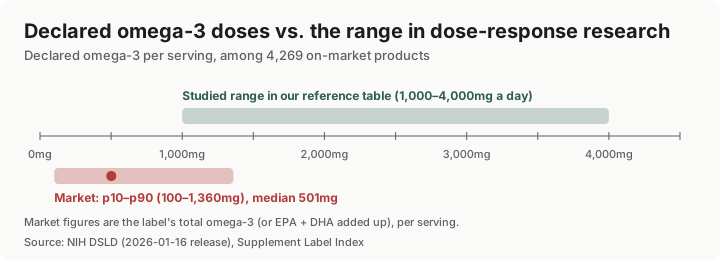
For each product we take the total omega-3 amount when the label has one, and otherwise add up the EPA and DHA lines. Across the 4,269 products with a disclosed amount, the median is 501 mg per serving, and the 10th to 90th percentile range runs from 100 mg to 1,360 mg. The 80th percentile is 1,020 mg, so roughly one product in five declares 1,000 mg or more.
Our reference table lists a studied range of 1,000 to 4,000 mg a day, anchored on a 2023 meta-analysis of 90 randomized trials that found triglyceride lowering rose close to linearly with dose, most clearly above 2 g a day in people with high blood lipids or excess weight. A larger Cochrane review of 86 trials found that long-chain omega-3 doses ran from 0.5 g a day to more than 5 g a day. Even the 90th-percentile product, at 1,360 mg per serving, sits below the 2 g a day where that meta-analysis saw the clearest effect. Two caveats matter here. The market figures are per serving and the studied figures are per day, so someone taking several softgels sits higher than the label’s single serving suggests. And the trials mostly enrolled people with specific conditions, so the studied range is not a target for everyone.
There is also no official yardstick on the other side. The Institute of Medicine set no RDA for EPA or DHA, set an adequate intake only for ALA, and did not establish a tolerable upper intake level. The FDA recommends not exceeding 3 g a day of EPA and DHA combined, with up to 2 g a day from supplements.
At the low end, 19.4% of products declare less than 200 mg, below what our fairy-dust threshold flags for this compound. Another 5.9% give no amount at all because the omega-3 sits inside a proprietary blend.
Triglyceride, ethyl ester, phospholipid
Omega-3 oils come in several chemical forms: natural triglycerides, free fatty acids, ethyl esters, re-esterified triglycerides, and phospholipids (the form in krill oil). In a 2010 trial of 72 volunteers taking about 3.3 g of EPA plus DHA daily for two weeks, bioavailability from re-esterified triglycerides was 124% of natural fish oil, free fatty acids were 91% (not significantly different), and ethyl esters were 73%. The NIH summary of the research puts it more gently: the triglyceride and free-acid forms have somewhat higher bioavailability than ethyl esters, but all forms significantly raise blood EPA and DHA. For krill oil’s phospholipids it describes only limited research suggesting somewhat higher bioavailability than fish oil.
It also helps to know that form and outcome are separate questions. The large REDUCE-IT trial, which found fewer cardiovascular events among 8,179 statin-treated patients with elevated triglycerides, used 4 g a day of icosapent ethyl, a purified EPA ethyl ester, and also saw more hospitalizations for atrial fibrillation or flutter (3.1% vs. 2.1%). An ethyl ester is not a defect, but it is a form to notice.
Labels rarely tell you which form you are getting. Our reference table has one ethyl ester form, DHA ethyl ester, which sits in the lowest quality tier on the strength of that trial, and it is the largest line for only 77 products (1.7%). The form may be described elsewhere on the package, or not at all, and the ingredient-level data cannot see it.
One formula, many labels
Fish oil is also one of the most heavily relabeled products. An exact formula-twin cluster whose first member is “Fish Oil 1,000 mg” holds 64 products from 25 brands, and another titled “Fish Oil 1000 mg / 300 mg Of Omega-3” holds 23 products from 11 brands. The second title shows the convention in plain sight: the oil weight leads and the omega-3 content follows. Identical declared formulas often reflect shared private-label manufacturing, which is why the brand name tells you little about what is inside.
Format matters too. Softgels make up 3,084 of the 4,572 products (67.5%), and 193 are gummies, whose median declared dose is 81 mg against 500 mg for capsules and tablets.
What the trials found
The evidence is mixed, and it is worth saying so. The Cochrane review of 86 trials and 162,796 participants found little or no effect of long-chain omega-3 on all-cause mortality (high-certainty evidence), and possibly a slight reduction in coronary heart disease events and deaths (low-certainty). It found a reduction in triglycerides of about 15%, in a dose-dependent way. REDUCE-IT, a single trial of a purified EPA product at a high dose, reached a more positive result. A label can tell you what a product declares, not whether a given dose will do anything for you.
What to check before comparing fish oil labels
- Find the EPA and DHA lines, not just the oil weight. “1,000 mg fish oil” on the front can mean about 300 mg of EPA plus DHA behind it.
- Check whether the amount is per serving or per softgel. Many labels define a serving as two or more softgels.
- A “total omega-3” line is not EPA plus DHA. It can include other omega-3s.
- Look for a stated form. If the label never says triglyceride, ethyl ester or phospholipid, you cannot tell which it is.
- Ask a pharmacist or doctor about interactions. The NIH notes omega-3 supplements can interact with some medications, and the FDA recommends no more than 3 g a day of EPA and DHA combined, up to 2 g from supplements.
You can explore the numbers on our omega-3 page or compare EPA versus DHA products head to head.
Sources
- National Institutes of Health, Office of Dietary Supplements. Omega-3 Fatty Acids: Fact Sheet for Health Professionals (typical fish oil supplement, forms and bioavailability, krill oil, intake reference values, FDA 3 g/day guidance).
- Dyerberg J et al. Bioavailability of marine n-3 fatty acid formulations. Prostaglandins Leukot Essent Fatty Acids 2010;83(3):137–141. PMID 20638827.
- Wang T et al. Association between omega-3 fatty acid intake and dyslipidemia: a continuous dose-response meta-analysis of randomized controlled trials. J Am Heart Assoc 2023;12(11):e029512. PMID 37264945.
- Abdelhamid AS et al. Omega-3 fatty acids for the primary and secondary prevention of cardiovascular disease. Cochrane Database Syst Rev 2020;3:CD003177. PMID 32114706.
- Bhatt DL et al. Cardiovascular risk reduction with icosapent ethyl for hypertriglyceridemia (REDUCE-IT). N Engl J Med 2019;380(1):11–22. PMID 30415628.
- Mayo Clinic. Mayo Clinic Minute: Figuring out fish oil.
- NIH Dietary Supplement Label Database, January 16, 2026 release; analysis by Supplement Label Index (methodology).
Follow new findings with the Insights RSS feed — it updates each time the label data refreshes.