Probiotic labels: CFU, strain names, and the blends that hide both
89.6% of probiotic ingredient rows sit inside a proprietary blend, the most of any compound we track. What CFU, strain names and 'through expiration' mean, and where the evidence is strain-specific.
By Alykhan Virani · October 2, 2026 · 7 min read · data from the January 16, 2026 DSLD release
A probiotic is unusual among common supplement ingredients: it has to be alive to count. That changes what a label can usefully tell you. A vitamin D label can state a milligram amount and be done. A probiotic label has to say which organism, how many of them are viable, and viable when. We looked at how the 4,150 on-market probiotic products in the NIH Dietary Supplement Label Database (DSLD) handle those three questions, and where the data stops being able to answer them.
The amount on the label can be a weight, not a count
Probiotics are counted in colony-forming units (CFU), the number of viable cells. The NIH Office of Dietary Supplements (ODS) notes that many supplements contain 1 to 10 billion CFU per dose and some contain 50 billion or more, and that higher counts are not necessarily more effective. It also makes a point that is easy to miss: current US labeling rules only require the total weight of the microorganisms on the Supplement Facts panel, and that mass can include dead cells, so it says nothing about how many are alive. Listing CFU is voluntary.
So a probiotic with a bare milligram amount and a probiotic with a CFU count are not declaring the same kind of thing. Only the second says anything about viability.
Why we are not publishing a dose spread
For most compounds on this site we show the full spread of declared doses. For probiotics we can’t, and it’s worth being specific about why. Our pipeline stored a per-product probiotic total for only 738 of the 4,150 products (17.8%). Those stored values run from 100 to 25.75 trillion, with a median of 30,000. A median of 30,000 CFU would sit more than four orders of magnitude below the 1 to 10 billion range ODS describes as common, which is not a believable market. The likeliest explanation is that DSLD records probiotic amounts in a mix of units (billions of CFU, millions of CFU, milligrams of culture), and our normalization handles each of them as if it were the same one.
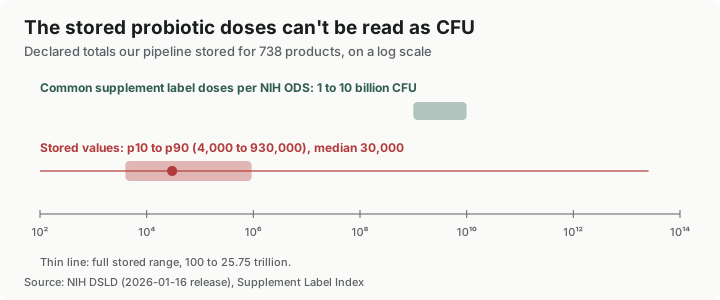
The practical consequence: any probiotic dose figure on this site, including the fairy-dust share, should not be read as a CFU measurement until the units are cleaned up. We’d rather say that than publish a chart we don’t trust.
The blend problem is the biggest in the market
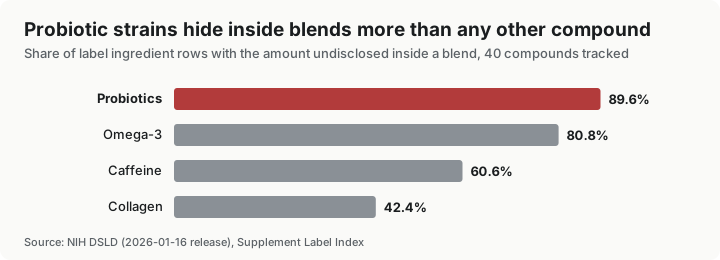
What the data does support is a different finding. 89.6% of probiotic ingredient rows in on-market labels sit inside a proprietary blend, the highest share of the 40 compounds we track. Omega-3 is second at 80.8%, caffeine third at 60.6%. For about 71% of probiotic products, the strains sit inside a blend and we found no total dose to report at all.
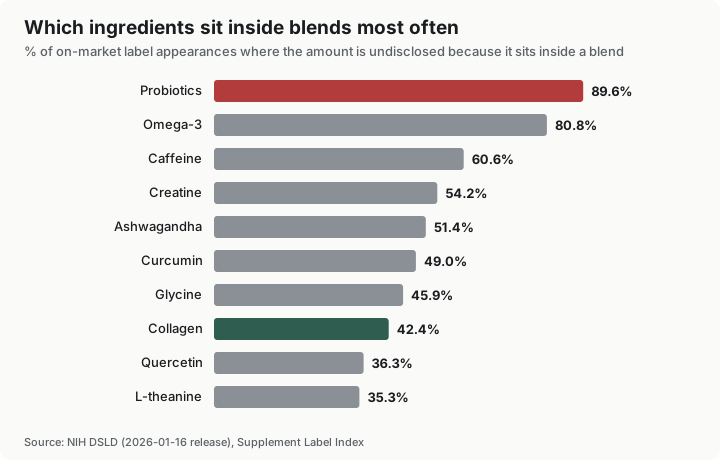
A caveat on the number: it counts ingredient rows, and a ten-strain product contributes ten rows, so multi-strain formulas weigh heavily. That is partly the point. A blend usually gives one total and a list of strains, with no count for any individual strain. The International Scientific Association for Probiotics and Prebiotics (ISAPP) says labels should give genus, species and strain for each organism, and notes that counts listed only by genus (“Lactobacillus” and “Bifidobacterium”) are still too little detail to tell what each strain contributes.
Strain names are where the evidence lives
A strain is not the same as a species. ODS describes a probiotic as identified by genus, species, subspecies where applicable, and an alphanumeric strain designation; its own example is Lacticaseibacillus rhamnosus GG, which carries the older name Lactobacillus rhamnosus GG on many labels because the genus was split into 25 genera in 2020. We match both naming conventions, so old and new names count together. We have not counted how many labels include a strain designation. Our reference table also deliberately does not grade probiotics by genus or species, because a tier for a whole genus or species would misrepresent how the research is organized.
That’s because ODS states that probiotic effects can be specific to certain strains, and that recommendations for clinical use therefore need to be strain-specific. Its own examples show how narrow the evidence can be. One assessment of 11 randomized trials found Lactobacillus rhamnosus GG most effective for infectious diarrhea at a daily dose of at least 10 billion CFU, and a review of 22 trials found Saccharomyces boulardii (most commonly 1 to 10 billion CFU a day) shortened diarrhea. Yet two later trials in 1,729 infants and young children, one of GG alone and one of GG combined with another strain, found no improvement over placebo. Evidence for one strain at one dose does not carry over cleanly to a different setting, let alone to a different strain.
The American Gastroenterological Association’s 2020 guideline takes the same approach: where it recommends probiotics at all, it names specific strains or strain combinations, for example for preterm infants, rather than treating probiotics as a class. Pooled analyses do exist, and they sometimes find a benefit across strains. A 2025 Cochrane review of 47 trials (15,260 participants) of probiotics of any strain or dose to prevent C. difficile-associated diarrhea found a lower incidence, with low-certainty evidence, and noted that authors were affiliated with a probiotic company or received industry funding in 28 of the included studies.
“At time of manufacture” versus “through expiration”
Because probiotics die over time, the date a count refers to matters as much as the count. ISAPP advises manufacturers to list CFU, ideally per strain, through the expiration or use-by date, and suggests consumers avoid products that list CFU only at time of manufacture, because that figure doesn’t account for the decline over a product’s life. ODS repeats the advice. One of the criteria published by Binda and colleagues for calling a strain a probiotic is that it is alive in the product at an efficacious dose throughout shelf life.
We could not extract from DSLD which date a CFU claim refers to, so we can’t tell you how many labels say which. It’s a line of text you have to check on the bottle.
Whether a label matches the contents is a separate question. A 2016 FDA analysis of ten popular US probiotic products found they mostly adhered to their ingredient claims, with a few naming discrepancies between closely related species, one product with an apparent unlisted Enterococcus contaminant in two of three lots, and only one product inaccurate in viability. Ten products is a small sample, and it says more about the method than about the market.
Format and who the labels are aimed at
Of the 4,150 products, 59% are capsules, 22% powders, 9% tablets and 3.5% (144) gummies or jellies; 103 of those 144 gummies list sugar. The target-group tags on the labels include 481 products for children 4 and older, 227 for ages 1 to 4, and 53 for infants under one. ODS notes that probiotics have been linked to bloodstream infections in some cases, mostly in people who were severely ill or immunocompromised, and that a 2023 FDA statement raised concerns about use in preterm infants. A target-group tag describes who a product is marketed to, not a dose that has been tested in that group.
What to check on a probiotic label
- Is the amount in CFU or only in milligrams? Only CFU speaks to viability.
- Does it name genus, species and a strain code for each organism? Strain designations are what trial evidence is attached to.
- Is the count per strain or per blend? A single blend total can’t tell you what each strain contributes.
- Is the count “through expiration” or “at time of manufacture”? The first accounts for die-off; the second doesn’t.
- Does a trial exist for that strain, at that dose, for the outcome you care about? That is a question about the strain, not the category.
Sources
- NIH Office of Dietary Supplements. Probiotics: Health Professional Fact Sheet (updated March 25, 2025). CFU and labeling, strain nomenclature, strain-specific evidence, trial doses, safety.
- Sanders ME. Decoding a Probiotic Product Label. International Scientific Association for Probiotics and Prebiotics (updated June 21, 2025).
- Binda S et al. Criteria to qualify microorganisms as "probiotic" in foods and dietary supplements. Front Microbiol 2020;11:1662. PMID 32793153.
- Zheng J et al. A taxonomic note on the genus Lactobacillus: description of 23 novel genera, emended description of the genus Lactobacillus Beijerinck 1901, and union of Lactobacillaceae and Leuconostocaceae. Int J Syst Evol Microbiol 2020;70(4):2782–2858. PMID 32293557.
- Su GL et al. AGA Clinical Practice Guidelines on the Role of Probiotics in the Management of Gastrointestinal Disorders. Gastroenterology 2020;159(2):697–705. PMID 32531291.
- Esmaeilinezhad Z et al. Probiotics for the prevention of Clostridioides difficile-associated diarrhea in adults and children (Cochrane meta-analysis). Cochrane Database Syst Rev 2025;9:CD006095. PMID 40931979.
- Patro JN et al. Culture-independent metagenomic surveillance of commercially available probiotics with high-throughput next-generation sequencing. mSphere 2016;1(2):e00057-16. PMID 27303722.
- Mayo Clinic. Probiotics: Mayo Clinic Radio.
- NIH Dietary Supplement Label Database, January 16, 2026 release; analysis by Supplement Label Index (methodology).
Follow new findings with the Insights RSS feed — it updates each time the label data refreshes.