Melatonin isn't a vitamin, and the market treats its dose that way
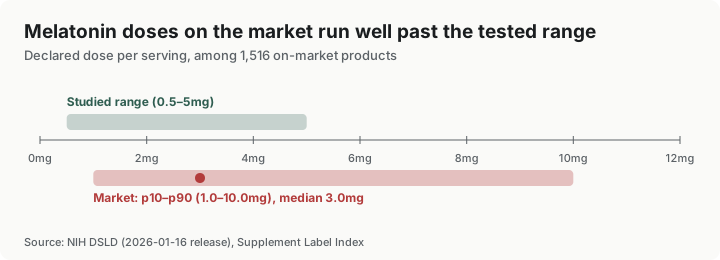
Melatonin has no RDA, no established UL, and no regulatory dose ceiling. On-market doses run 1–10mg; the research behind its sleep-onset effect mostly used 0.5–5mg.
By Alykhan Virani · September 27, 2026 · 4 min read · data from the January 16, 2026 DSLD release
Every compound we’ve covered on this site so far, magnesium, curcumin, niacin, has an official reference point: an RDA, a UL, or both, set by a federal or international body after reviewing the evidence. Melatonin doesn’t. It’s a neurohormone your own pineal gland makes, not an essential nutrient, and no US agency has set a recommended intake or a maximum safe dose for it. It’s sold as a dietary supplement anyway, at doses the market itself has been free to decide.
What “no regulatory ceiling” looks like in practice
Among the 1,516 on-market melatonin products with a disclosed per-serving dose, the middle 80% runs from 1mg to 10mg, with a median of 3mg. The largest meta-analysis of melatonin for sleep-onset problems, a 2013 review of 19 randomized trials and 1,683 subjects, mostly tested doses between 0.5mg and 5mg. The market’s own middle range already reaches twice that ceiling.
To be fair to higher-dose products, that same meta-analysis found higher doses and longer duration of use were associated with a larger effect on sleep-onset time, so “higher than what most trials tested” isn’t automatically “unsupported by any evidence.” What it does mean is that a 10mg gummy and a 0.5mg trial dose are different enough that results from one don’t necessarily tell you what to expect from the other, and the gap between the two is wider for melatonin than it is for a nutrient with an RDA holding the low end in place.
Notably, this isn’t the “fairy dust” problem we’ve flagged in other compounds, where a product declares an amount so small it’s unlikely to do anything at all. Only 0.1% of melatonin products fall below that threshold here. The market’s melatonin problem, to the extent it has one, runs in the opposite direction from proprietary-blend-style underdosing: too high relative to the evidence base, not too low.
The one gummy dose that runs the “wrong” way
We’ve written before about gummies generally delivering less active ingredient than the same compound in a capsule, sometimes far less. Melatonin is one of the few compounds that runs the opposite direction: the median melatonin gummy declares 5mg per serving, against 3mg for capsules and tablets — a higher dose in the format that’s easier to over-consume, not a lower one.
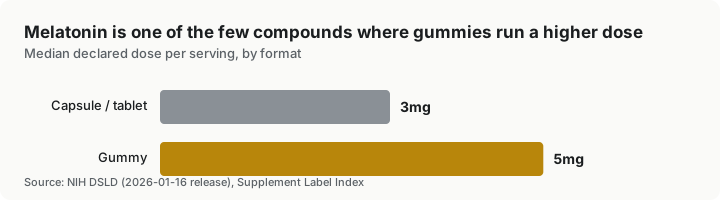
That combination, a candy-like format carrying a higher median dose than the pill version, is exactly the pattern behind a real and well-documented safety problem, not with melatonin’s effect on sleep, but with small children getting into a bottle unsupervised.
What the CDC actually found
A 2022 CDC report tracked pediatric melatonin ingestions reported to US poison control centers from 2012 through 2021. The numbers are large enough to be worth stating plainly: 260,435 pediatric melatonin ingestions over the decade, with the annual count rising 530%, from 8,337 in 2012 to 52,563 in 2021. Of the cases serious enough to be managed at a healthcare facility, 4,097 required hospitalization and 287 needed intensive care; five children needed mechanical ventilation, and two children under age 2 died. The report specifically flags chewable (gummy) products as the formulation with the most dose variability, citing a separate Canadian analysis that found melatonin content varying by as much as 465% between product lots.
The CDC’s own read on why the numbers rose so fast points mostly to accessibility: melatonin sales climbed sharply over the same period, unsupervised access to a widely available bottle in the home is the common thread across most of these cases, not a change in how the ingredient itself behaves. It’s also worth being precise about what these numbers are and aren’t: they’re ingestions reported to poison control, overwhelmingly involving young children getting into a product on their own, not evidence about the ordinary, supervised use most adults and parents practice. But a bottle of gummies that looks and often tastes like candy, sitting on a nightstand or in a kitchen drawer, is a real and specific version of the accessibility problem the report describes.
Sold for children anyway, with no pediatric reference dose
Despite all of this, melatonin products aimed at children are a real, non-trivial part of the market: 159 on-market melatonin products carry an explicit children’s target-group label in DSLD (130 for ages 4 and up, 25 for ages 1 to 4, 4 more for “children, all ages”). None of them are anchored to an established pediatric dose the way a children’s vitamin might be, because, again, no such reference value exists for melatonin at any age. A “kids’ formula” label describes who a product is marketed to, not a dose that’s been vetted the way an RDA-backed nutrient’s would be.
What to check before giving or taking melatonin
- Store it like a medication, not a vitamin. Given how much of the CDC’s data traces back to unsupervised access, keeping any melatonin product, gummy or otherwise, out of a child’s reach matters more than the specific dose on the label.
- A “kids’” label isn’t a vetted pediatric dose. There’s no official reference value behind it the way there is for a children’s multivitamin’s nutrients.
- Check the actual milligram number, not just “melatonin.” Products range at least 20-fold across the market, from well under 1mg to 10mg or more in a single serving.
- More isn’t automatically better, but it isn’t automatically pointless either. The evidence genuinely points toward a dose-response relationship; the issue is that a meaningful share of the market sits above the range that evidence was built on.
Sources
- Ferracioli-Oda E et al. Meta-analysis: melatonin for the treatment of primary sleep disorders. PLoS One 2013;8(5):e63773 (19 RCTs, 1,683 subjects). PMID 23691095.
- Lelak K et al. Pediatric Melatonin Ingestions — United States, 2012–2021. MMWR Morb Mortal Wkly Rep 2022;71:725–729. CDC MMWR.
- National Center for Complementary and Integrative Health. Melatonin: What You Need To Know.
- Mayo Clinic Health System. Is melatonin safe for children?
- NIH Dietary Supplement Label Database, January 16, 2026 release; analysis by Supplement Label Index (methodology).
Follow new findings with the Insights RSS feed — it updates each time the label data refreshes.