CoQ10 labels: ubiquinone vs. ubiquinol, and why the softgel matters too
97.6% of CoQ10 labels declare ubiquinone, 2.4% ubiquinol. The median is 60 mg, one 100 mg formula is sold by 92 brands, and absorption depends on the oil the CoQ10 sits in.
By Alykhan Virani · October 2, 2026 · 5 min read · data from the January 16, 2026 DSLD release
Coenzyme Q10 is not a vitamin. Your body makes it, so there is no RDA, and the National Cancer Institute’s research summary describes it as a compound the human body synthesizes naturally. Supplements are a different story: 3,254 on-market products in the NIH Dietary Supplement Label Database (DSLD) declare CoQ10 in the January 2026 release. Because CoQ10 is fat-soluble, the same NCI summary notes it is absorbed best with fat, so lipid preparations are absorbed better than the purified compound. That one fact turns out to matter as much as anything printed on the label.
Two forms, and almost everyone picks one
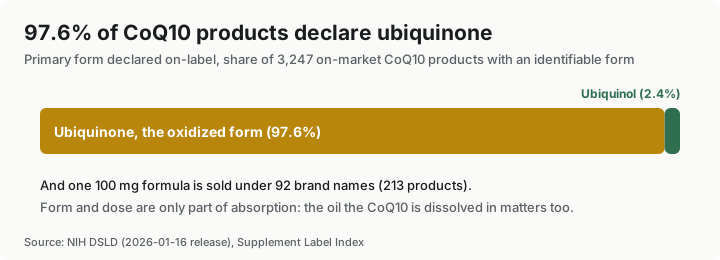
CoQ10 comes in an oxidized form, ubiquinone, and a reduced form, ubiquinol. Among the 3,247 products where we can identify the form, 3,170 (97.6%) declare ubiquinone and 77 (2.4%) declare ubiquinol. That count includes labels that say only “CoQ10”, which our reference table treats as ubiquinone by default. Ubiquinol is growing from a tiny base: by the year a product entered DSLD, it accounted for 1 product a year from 2015 to 2018, then 24 of 355 (6.8%) in 2024.
Our reference table places ubiquinol in a higher quality tier than ubiquinone because of a small 2014 study: 12 healthy volunteers took 200 mg a day of each form, one after the other, in softgel capsules with identical excipients, for four weeks apiece. Plasma CoQ10 rose from 0.9 to 2.5 µg/mL on ubiquinone and to 4.3 µg/mL on ubiquinol. That is real evidence for better bioavailability, but it measures blood levels in 12 people, not any outcome you would notice, and a tier summarizes that evidence rather than rating a product.
The oil matters as much as the form
A 2019 crossover trial tested seven different 100 mg CoQ10 supplements in 14 healthy young volunteers and measured plasma levels over 48 hours. Absorption differed widely, and the two best-absorbed products were softgel capsules, one containing ubiquinone and one ubiquinol. The matrix used to dissolve the CoQ10, and additives such as vitamin C, also affected absorption, and individuals differed in how much they absorbed.
In our data, 1,006 CoQ10 products (30.9%) are softgels, 1,209 (37.2%) are other capsules, 463 (14.2%) tablets, 222 (6.8%) powders, and 42 gummies. The physical-form field cannot tell you what is inside a capsule, so a “capsule” might hold CoQ10 dissolved in oil or a dry powder. If absorption matters to you, the label’s form line is a start, not the whole answer.
How much CoQ10 is declared
Across the 2,754 products with a disclosed amount, the median is 60 mg per serving; the 10th percentile is 8 mg and the 90th is 200 mg. The 60th, 70th and 80th percentiles all land on exactly 100 mg, so at least about one product in five declares precisely that.
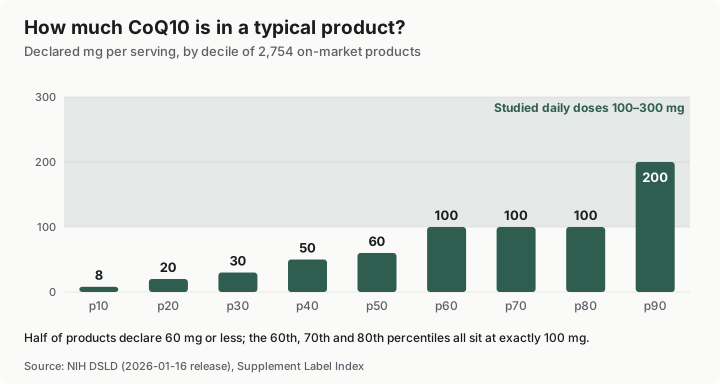
Our reference table lists a studied range of 100 to 300 mg a day. The two trials behind it both used 100 mg three times a day. In Q-SYMBIO, 420 patients with moderate to severe heart failure took CoQ10 or placebo on top of standard therapy for two years. Short-term measures did not change significantly, but major adverse cardiovascular events occurred in 15% of the CoQ10 group versus 26% of the placebo group. A smaller trial of 42 migraine patients found a 50%-responder rate for attack frequency of 47.6% on CoQ10 versus 14.4% on placebo. The NCI summary says human studies usually used 90 to 390 mg a day.
Set against that, at least half of products declare 60 mg or less per serving, and 19.2% fall below 20 mg, our fairy-dust threshold for this compound. Two reminders: the market figures are per serving while the trial doses are per day, and those trials enrolled people with specific conditions. Another 12.8% of products give no amount because the CoQ10 sits inside a proprietary blend.
One much-studied question is whether CoQ10 helps with muscle symptoms from statins, and the reviews do not agree. A 2015 meta-analysis of 6 trials and 302 patients found no significant benefit, and called for larger trials. A 2018 update pooling 12 randomized trials and 575 patients found improvement in muscle pain, weakness, cramps and tiredness.
The 92-brand formula
CoQ10 is also home to the single largest formula-twin cluster in the whole database: 213 products, sold under 92 brand names, with an identical declared compound, form, amount and serving size (“Super CoQ-10 100 mg” is its first member). The next two CoQ10 clusters hold 98 products from 53 brands (200 mg) and 70 products from 41 brands (100 mg).
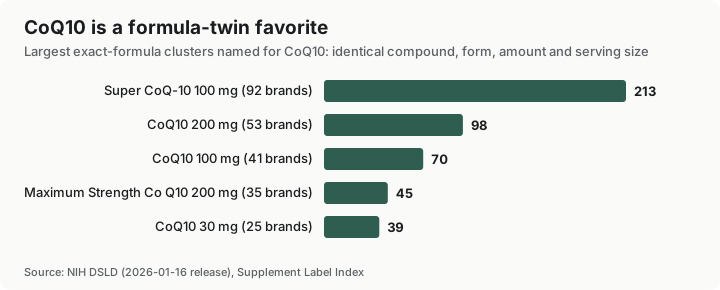
Many identical declared formulas reflect private-label manufacturing, and we covered how that works in an earlier post. For CoQ10 there is a specific wrinkle. The twin fingerprint covers the compound, form, amount and serving size, but not the physical form or the carrier oil, so two “twins” can in principle differ in the very thing the 2019 trial found mattered, and the label data cannot say. The same goes for excipients such as the oil itself. Matching labels means matching declared recipes, not matching absorption.
What to check before comparing CoQ10 labels
- Find the form line. “Ubiquinone” and “ubiquinol” are the two forms; a label that says only “CoQ10” does not tell you which, and our table defaults it to ubiquinone.
- Look at the capsule type. Softgels were the best-absorbed format in the 2019 trial, but that is one study of 14 people.
- Compare milligrams per serving, then check the serving size. Trials used 100 mg three times a day; a 100 mg label is one serving of that.
- Read an identical formula as a shared recipe. Matching labels can still differ in carrier oil or manufacturing.
- Ask a professional if you take medication or have a heart condition. Several of the studies above used CoQ10 alongside standard therapy, not instead of it.
You can explore the underlying numbers on our CoQ10 page, or see the full ranking of clusters on the Formula Twins report.
Sources
- National Cancer Institute. Coenzyme Q10 (PDQ), Health Professional Version (synthesized by the body; absorbed best with fat; usual study doses).
- Langsjoen PH, Langsjoen AM. Comparison study of plasma coenzyme Q10 levels in healthy subjects supplemented with ubiquinol versus ubiquinone. Clin Pharmacol Drug Dev 2014;3(1):13–17. PMID 27128225.
- López-Lluch G et al. Bioavailability of coenzyme Q10 supplements depends on carrier lipids and solubilization. Nutrition 2019;57:133–140. PMID 30153575.
- Mortensen SA et al. The effect of coenzyme Q10 on morbidity and mortality in chronic heart failure: results from Q-SYMBIO. JACC Heart Fail 2014;2(6):641–649. PMID 25282031.
- Sándor PS et al. Efficacy of coenzyme Q10 in migraine prophylaxis: a randomized controlled trial. Neurology 2005;64(4):713–715. PMID 15728298.
- Banach M et al. Effects of coenzyme Q10 on statin-induced myopathy: a meta-analysis of randomized controlled trials. Mayo Clin Proc 2015;90(1):24–34. PMID 25440725.
- Qu H et al. Effects of coenzyme Q10 on statin-induced myopathy: an updated meta-analysis of randomized controlled trials. J Am Heart Assoc 2018;7(19):e009835. PMID 30371340.
- Mayo Proceedings. Effects of Coenzyme Q10 on Statin-Induced Myopathy.
- NIH Dietary Supplement Label Database, January 16, 2026 release; analysis by Supplement Label Index (methodology).
Follow new findings with the Insights RSS feed — it updates each time the label data refreshes.