Collagen supplements: what labels declare vs. the doses that were studied
The median collagen product declares 1.8 g per serving; the cited trials used 2.5 to 15 g. Gummies run far lower. How hydrolyzed peptides, gelatin and UC-II differ, and what labels leave unsaid.
By Alykhan Virani · October 2, 2026 · 6 min read · data from the January 16, 2026 DSLD release
Your body makes its own collagen, so it isn’t an essential nutrient, and there is no RDA to hold a label against. Collagen supplements are sold anyway, in powders, capsules and gummies, mostly as “hydrolyzed collagen” or “collagen peptides.” We analyzed the 1,628 on-market collagen products in the NIH Dietary Supplement Label Database (DSLD) and compared what they declare with the doses used in clinical trials.
The dose on the label vs. the dose in the trials
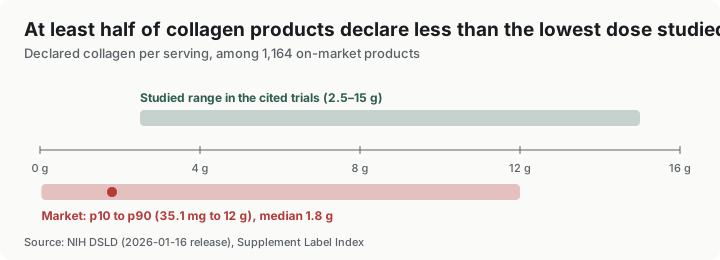
Of the 1,628 products, 1,164 (71.5%) declare a per-serving amount we could read. Doses are counted on the label’s first column, the first serving column, so a product that recommends several servings a day can deliver more than the number we report. The median declared dose is 1.8 g per serving, and the spread is wide: the 10th percentile is 35 mg, the 90th is 12 g.
The trials we cite sit at 2.5 g and above. In a double-blind trial of 69 women aged 35 to 55, 2.5 g and 5 g a day of a collagen hydrolysate for eight weeks both improved skin elasticity compared with placebo. At the other end, a trial of 53 men with sarcopenia (average age 72) used 15 g a day for 12 weeks alongside resistance training. That gives a studied range of 2.5 to 15 g. Because the median is 1.8 g, at least half of the products with a declared dose list less than the lowest dose we cite, and 34.1% list under 500 mg, the point at which our fairy-dust threshold (20% of the lowest studied dose) flags a token amount. At the top, the 90th percentile of 12 g is still inside the studied range.
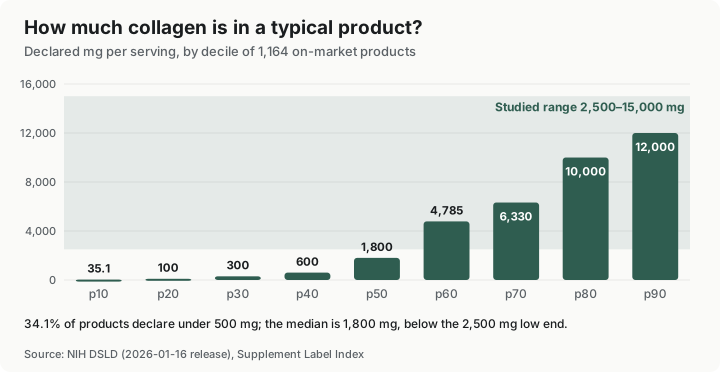
A product below the range isn’t mislabeled, and being inside it is not evidence of an effect. It means the declared amount differs from what the studies tested, so their results don’t automatically apply.
Gummies sit furthest from the studied range
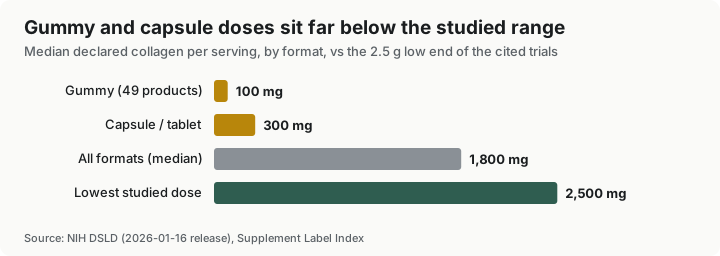
Powders are the largest format (644 products, 39.6%), followed by capsules (478, 29.4%) and tablets (208, 12.8%). Gummies are 49 products, 3.0%. Among products that declare a dose, the median collagen gummy lists 100 mg per serving, against 300 mg for capsules and tablets. Both are well under the 2,500 mg low end, and the gummy median is about 4% of it. Gummies also carry sugar: 42 of the 49 list it, with a median of 3 g per serving. We don’t have a dose breakdown for powders from these figures, so we can’t say how they compare.
“Collagen” is several different materials
Collagen is a family of proteins; nearly 28 types have been identified. Type I is the most common in skin, bone and tendon, and type II is found in cartilage. Supplements add a second layer of difference, which is how the collagen was processed.
- Hydrolyzed collagen (peptides). Collagen is denatured and then cut by enzymes into small peptides of roughly 3 to 6 kDa, far smaller than native collagen at about 300 kDa. Most of the skin and muscle trials above used this kind of material.
- Gelatin. Sometimes used interchangeably with collagen on labels. We found no head-to-head human trial of gelatin against hydrolyzed peptides at equal doses. Gelatin does have its own research: a small crossover study of 8 men gave 5 or 15 g of vitamin C-enriched gelatin and measured a blood marker of collagen synthesis, which is a biomarker, not a clinical outcome.
- Undenatured type II collagen (UC-II). A distinct material derived from chicken sternum cartilage, tested at 40 mg a day, not grams. In a 180-day trial of 191 volunteers with knee osteoarthritis, it lowered the WOMAC symptom score compared with placebo and with glucosamine plus chondroitin. A 40 mg UC-II dose and a 10 g peptide dose are not comparable.
Of the 1,517 products where we could identify a form, 96.7% fall in the hydrolyzed Type I/III peptide bucket, 3.2% are hydrolyzed type II, and one product is gelatin. That first number is partly an assumption. Many labels say only “collagen” with no processing stated, and our reference table defaults those to hydrolyzed peptides as the most common commercial form, flagged for review. Our table has a separate UC-II entry, but no product is currently classified in it, so we can’t say how much of the 3.2% is undenatured, or how many “gelatin” labels are sitting under the default. Labels do use the words loosely: one group of 12 products that share an identical declared formula includes both “Collagen Peptides Unflavored” and “Beef Gelatin Unflavored.” Our quality tiers rank peptides first and type II lower because fewer independent trials exist; that summarizes the evidence and is not a rating of any product.
Blends and commodity powders
42.4% of collagen ingredient rows sit inside a proprietary blend, the eighth-highest of the 40 compounds we track, and 25.3% of collagen products had a blend and no collagen dose we could read. Many unflavored collagen powders are close to a commodity: one exact-formula cluster holds 23 products across 12 brand names and another holds 21 across 14, so many labels are the same formula twin under different names.
What the evidence does and doesn’t show
For skin, a 2023 meta-analysis of 26 randomized trials (1,721 participants) found hydrolyzed collagen improved hydration and elasticity versus placebo, and a 2021 review of 19 studies (1,125 participants) found favorable results for hydration, elasticity and wrinkles. The 2023 authors also reported several biases in the included trials and called for larger studies. For knee osteoarthritis, an updated 2025 analysis of 11 trials (870 participants) found better function and pain scores with collagen supplements, but with large differences between trials (heterogeneity of 75% for function and 88% for pain).
Two caveats apply to all of it. The trials tested specific products, such as a particular collagen hydrolysate, while a label says “hydrolyzed collagen,” so a trial’s result belongs to the material it used. And funding matters: the sarcopenia trial disclosed that part of its costs was paid by Gelita AG, a manufacturer of gelatin and collagen peptides, though it also states there were no conflicts of interest and that the investigators ran the study independently.
What to check on a collagen label
- Find the milligrams or grams per serving. The product name often says “collagen” with no number, and the studied doses are in grams.
- Check the serving size and how many servings the label recommends. Our figures use the first serving column only.
- Look for the material. “Hydrolyzed collagen,” “collagen peptides,” “gelatin” and “undenatured type II collagen” are different things, studied at very different doses.
- See whether collagen is listed alone or inside a blend. In a blend, the label gives a total and not the collagen’s share.
- For gummies, compare the collagen amount to the sugar. The median gummy lists 100 mg of collagen and 3 g of sugar.
Sources
- Proksch E et al. Oral supplementation of specific collagen peptides has beneficial effects on human skin physiology: a double-blind, placebo-controlled study. Skin Pharmacol Physiol 2014;27(1):47–55 (69 women, 2.5 or 5.0 g/day, 8 weeks). PMID 23949208.
- Zdzieblik D et al. Collagen peptide supplementation in combination with resistance training improves body composition and increases muscle strength in elderly sarcopenic men: a randomised controlled trial. Br J Nutr 2015;114(8):1237–1245 (53 men, 15 g/day, 12 weeks). PMID 26353786; funding statement in the full text.
- Pu SY et al. Effects of oral collagen for skin anti-aging: a systematic review and meta-analysis. Nutrients 2023;15(9):2080 (26 RCTs, 1,721 participants). PMID 37432180.
- de Miranda RB et al. Effects of hydrolyzed collagen supplementation on skin aging: a systematic review and meta-analysis. Int J Dermatol 2021;60(12):1449–1461 (19 studies, 1,125 participants). PMID 33742704.
- Simental-Mendía M et al. Effect of collagen supplementation on knee osteoarthritis: an updated systematic review and meta-analysis of randomised controlled trials. Clin Exp Rheumatol 2025;43(1):126–134 (11 RCTs, 870 participants). PMID 39212129.
- Shaw G et al. Vitamin C-enriched gelatin supplementation before intermittent activity augments collagen synthesis. Am J Clin Nutr 2017;105(1):136–143 (8 men, 5 or 15 g gelatin). PMID 27852613.
- Lugo JP et al. Efficacy and tolerability of an undenatured type II collagen supplement in modulating knee osteoarthritis symptoms: a multicenter randomized, double-blind, placebo-controlled study. Nutr J 2016;15:14 (191 volunteers, 40 mg/day UC-II). PMID 26822714.
- León-López A et al. Hydrolyzed collagen: sources and applications. Molecules 2019;24(22):4031 (collagen types, peptide size). PMID 31703345.
- Gelita AG. Company description: Wikipedia.
- Mayo Clinic. Mayo Clinic Minute: Can collagen supplements help with aging?
- NIH Dietary Supplement Label Database, January 16, 2026 release; analysis by Supplement Label Index (methodology).
Follow new findings with the Insights RSS feed — it updates each time the label data refreshes.