The Claims Census: what US supplement labels actually say
251,337 label statements analyzed. Most common phrases, where risk-reduction wording comes from, and why 94.5% of iron and 91.4% of caffeine products carry a warning statement.
By Alykhan Virani · October 2, 2026 · 6 min read · data from the January 16, 2026 DSLD release
Most conversations about supplement claims start from marketing: the loudest promise on a bottle, the most outlandish ad. We wanted to start from the other end and count. The NIH Dietary Supplement Label Database (DSLD) records the free-text statements printed on each label, and we analyzed every one attached to a currently on-market product: 251,337 statements. This post is a descriptive look at what those statements say and which kinds of text are common. It isn’t a ranking of anyone’s claims, and nothing here says whether a given statement is true.
What the census counts, and what it doesn’t
The definition matters, so here is exactly what we measure. DSLD tags each statement with a type. We bucket anything typed “General Statements” as a claim and anything typed “Precautions re:” as a warning. That’s a heuristic on DSLD’s own labels, not a legal classification, and the “claim” bucket is broader than it sounds. It holds structure/function wording, but also origin statements (“made in the U.S.A.”), packaging notes, panel footnotes, and educational copy. We can’t isolate the statements the FDA would formally call structure/function claims.
To rank phrases we break each statement into 5-word sequences and count the distinct brands that use each one, not raw occurrences. An early run showed why: one brand’s identical boilerplate, repeated across thousands of its own products, swamped everything else. Counting brands means a phrase only ranks high if many separate companies print it.
What the most common phrases are
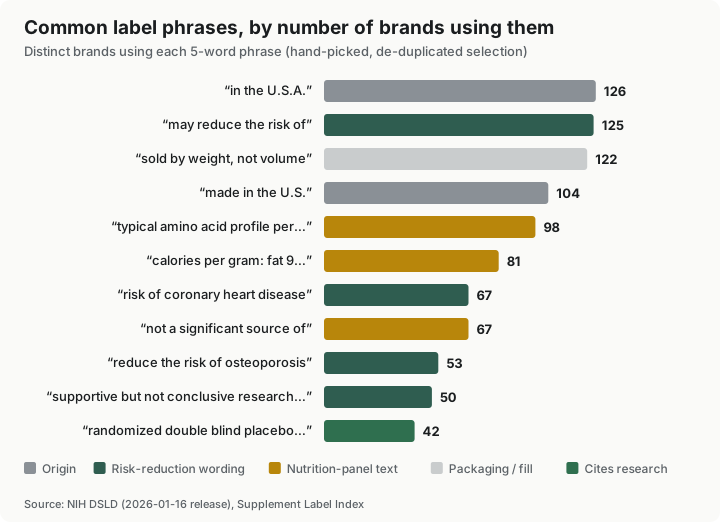
Most of the top of the list isn’t about health at all. The most widely shared phrase, “in the U.S.A.”, appears on 126 brands, followed by “may reduce the risk of” (125), “sold by weight not volume” (122), and “made in the U.S.” (104). Then come nutrition-panel text: “typical amino acid profile per serving” (98 brands) and the “calories per gram: fat 9, carbohydrate 4, protein 4” footnote (81).
Break it down by product type and the pattern is clear. Packaging language (“sold by weight, not volume; some settling may occur”) features prominently in amino acid, protein, and fiber products. Botanical labels lean on “conforms to USP 2091 for weight” (25 brands) and traditional-use framing such as “has been used for centuries” (24). The descriptive, structure/function-style phrases that many people picture as “the claims” are present but not dominant: “plays an important role in” is on 62 brands and “is one of the most” on 63.
Where the risk-reduction wording comes from
“May reduce the risk of” deserves a closer look because it is legally a different kind of statement. Under the 1994 Dietary Supplement Health and Education Act, which the FDA describes as a post-market model, with no pre-approval of supplements, a supplement label can describe a nutrient’s role in the body’s structure or function but cannot claim to diagnose, treat, cure, or prevent a disease. Structure/function statements need no FDA approval; the company must notify the FDA within 30 days of first marketing, certify it has substantiation, and print the standard disclaimer: “This statement has not been evaluated by the Food and Drug Administration. This product is not intended to diagnose, treat, cure, or prevent any disease.”
Disease-risk wording is a separate category, the health claim, and it is tightly scripted. The census shows where it clusters. By product type, “may reduce the risk of” appears on 52 brands of fatty-acid products and 27 brands of single vitamin and mineral products, and “reduce the risk of osteoporosis” is on 53 brands overall. The FDA’s authorized calcium claim carries conditions: the product must be high in calcium, the calcium must be assimilable, and the claim can’t attribute a degree of risk reduction. For fish oil, the FDA exercised enforcement discretion in 2004 for a qualified claim, “Supportive but not conclusive research shows that consumption of EPA and DHA omega-3 fatty acids may reduce the risk of coronary heart disease.” We see that opening phrase on 50 brands. Several of the most common risk-reduction phrases in the data, in other words, match FDA-recognized wording. That is consistent with brands using the scripted claims, though phrase counts can’t tell us whether each label also meets the underlying conditions.
Warning statements: iron and caffeine
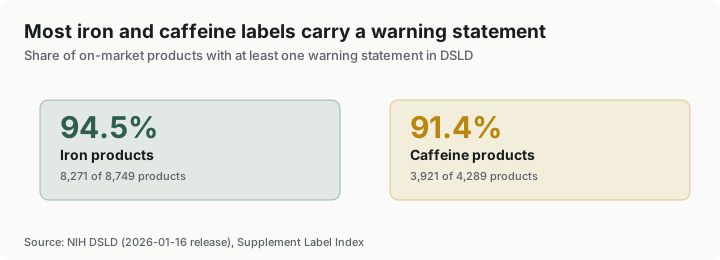
For two compounds we checked whether a warning statement is present at all. Among 8,749 products declaring iron, 94.5% (8,271) have at least one warning-type statement in DSLD; among 4,289 declaring caffeine, 91.4% (3,921) do.
Iron has a specific federal rule behind it. FDA regulation 21 CFR 101.17(e) requires a boxed warning on dietary supplements in solid oral dosage form (such as tablets or capsules) that contain iron or iron salts as an iron source: “WARNING: Accidental overdose of iron-containing products is a leading cause of fatal poisoning in children under 6. Keep this product out of reach of children. In case of accidental overdose, call a doctor or poison control center immediately.” We don’t map our caffeine figure to a particular legal requirement; it is simply how often any warning appears.
Please don’t read the remaining 5.5% of iron products (478) as violations. Our test is crude in three ways. It counts any “Precautions re:” statement, not the iron wording specifically. Our iron denominator likely includes powders, liquids, and products with iron as a minor ingredient that the rule may not cover. And DSLD may record a label’s warning text in a field we aren’t reading. What the figure does show is that, for the products we could test, warnings are the norm.
Fewer statements per label than a decade ago
Among labels that have any general statements, the average count per label peaked at about 5.5 for labels first entered in 2015 and fell to about 1.5 for those entered in 2024 and 2025.
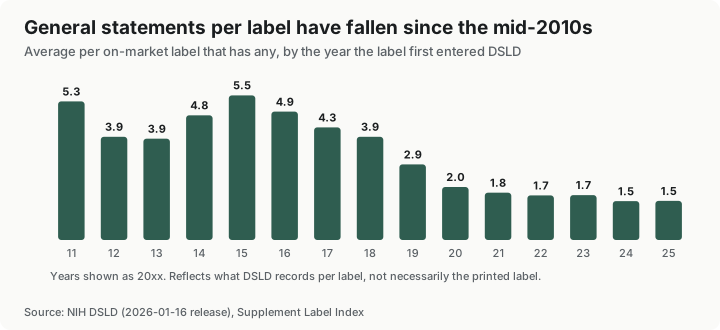
We’d be cautious about the cause. This measures what DSLD records, which depends on how each manufacturer’s submission is transcribed, not necessarily how much text is printed. A real shift toward sparser labels is one explanation; shorter or more structured submissions is another, and these data can’t separate them.
What to check when reading label statements
- Look for the asterisk and the disclaimer. A structure/function statement is supposed to carry the “not evaluated by the FDA” disclaimer; it means the statement wasn’t reviewed in advance, not that it’s false.
- Separate “supports” language from “reduces the risk of” language. The second is disease-risk wording and, for supplements, is expected to follow an FDA-recognized claim.
- Treat “made in the U.S.A.” and “sold by weight” as facts about packaging and origin, not about benefit.
- A warning statement is information, not a rating. Its presence says little about a product’s quality either way.
- Remember the data’s limits. DSLD records what manufacturers submitted; we haven’t checked any statement against the physical label or against the evidence behind it.
The full phrase table and per-year series are on the Claims Census report.
Sources
- US Food and Drug Administration. 21 CFR 101.93: Certain types of statements for dietary supplements (30-day notification, required disclaimer text, permitted structure/function and disease-claim definitions).
- US Food and Drug Administration. 21 CFR 101.17(e): Dietary supplements containing iron or iron salts (required warning).
- US Food and Drug Administration. 21 CFR 101.72: Health claims: calcium, vitamin D, and osteoporosis.
- US Food and Drug Administration. Structure/Function Claims.
- US Food and Drug Administration. Dietary Supplements (DSHEA 1994 and the post-market regulatory model).
- US Food and Drug Administration. Qualified Health Claims: Letter of Enforcement Discretion, Omega-3 Fatty Acids and Reduced Risk of Coronary Heart Disease (Martek petition), September 8, 2004. Archived letter; index at FDA Qualified Health Claims: Letters of Enforcement Discretion.
- US Food and Drug Administration. FDA's Regulation of Dietary Supplements with Dr. Cara Welch.
- NIH Dietary Supplement Label Database, January 16, 2026 release; analysis by Supplement Label Index (methodology). Claims are DSLD statements typed "General Statements"; warnings are statements typed "Precautions re:"; phrases are 5-word sequences ranked by distinct brands.
Follow new findings with the Insights RSS feed — it updates each time the label data refreshes.