The Cheap Form Index: why curcumin and ashwagandha labels rarely match the research
98.1% of curcumin products use the form absorbed worst, and only 3.2% of ashwagandha products use the extract studied in clinical trials. Here is why the form matters as much as the ingredient.
By Alykhan Virani · September 22, 2026 · 5 min read · data from the January 16, 2026 DSLD release
A bottle of curcumin and a bottle of ashwagandha can carry the same milligram number and mean very different things. Both ingredients are backed by real clinical research, but the specific material used in that research is often not the material sold under the same name on a shelf. We looked at every product in the NIH Dietary Supplement Label Database (DSLD) to see how often the label matches the studied form, for these two of the market’s most popular botanicals.
Curcumin: one form dominates, and it’s the one studied least favorably
Curcumin, the pigment compound in turmeric, is poorly absorbed on its own. It is not very soluble in water, and the body metabolizes and clears it quickly, so plain curcumin passes through largely unused. Formulators have spent years working around that, producing versions bound to phospholipids, nanoparticles or other delivery systems meant to raise blood levels.
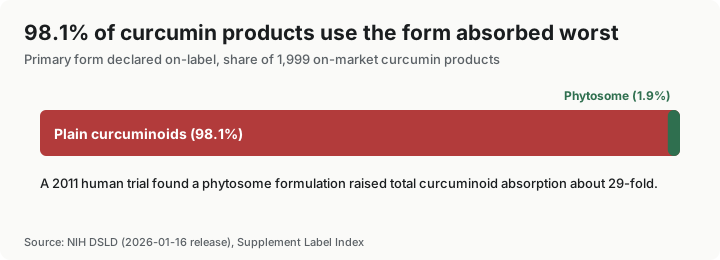
Across 1,999 on-market curcumin products where we could identify a primary form, 98.1% use plain curcuminoids, the baseline, lowest-absorption form, and only 1.9% use a phytosome-type formulation.
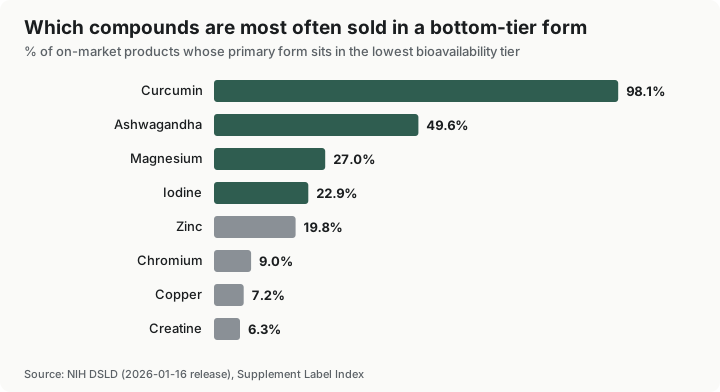
Across the 39 compounds we track this way, curcumin tops the list by a wide margin. A 2011 randomized, double-blind, crossover trial by Cuomo and colleagues in the Journal of Natural Products compared a lecithin-based phytosome formulation (marketed as Meriva) with the same unformulated curcuminoid mixture in healthy volunteers. Total curcuminoid absorption was about 29-fold higher with the phytosome. The caveat is important: even at that higher level, only phase-2 metabolites were detected, and plasma concentrations were still well below what would be needed to inhibit most of curcumin’s proposed anti-inflammatory targets. Better absorption is not the same as a proven clinical effect at that dose.
What “curcuminoids” and “phytosome” actually mean
“Curcuminoids” is the umbrella term for curcumin and its two related compounds (demethoxycurcumin and bisdemethoxycurcumin), all naturally present in turmeric root. A label reading “Curcuminoids 500 mg” or “Turmeric Extract (95% Curcuminoids)” is describing this baseline material: concentrated relative to raw turmeric powder, but not modified to help the body absorb it.
A phytosome binds the curcuminoid molecules to phospholipids, the fat molecules that make up cell membranes, which appears to help them cross the intestinal wall. It is a formulation technique, not a different plant or extraction ratio, and it is only one of several approaches sold today; others combine curcumin with piperine (black pepper extract) or use nanoparticle and micellar delivery systems, each tested separately and not interchangeable with the phytosome data above.
Ashwagandha: three products for the price of one name
Ashwagandha is even more fragmented. Products sold under that single name can be root powder, an unstandardized extract, or a standardized extract guaranteed to contain a minimum percentage of withanolides, the compound class believed to drive its effects. These are not interchangeable, and the clinical evidence sits almost entirely with one category.
Of 2,228 on-market ashwagandha products, 49.6% are plain root powder with no guaranteed active content, 47.2% are an extract with no standardization guarantee, and just 3.2% are a standardized extract of >=5% withanolides, the type of material used in the largest clinical trials.
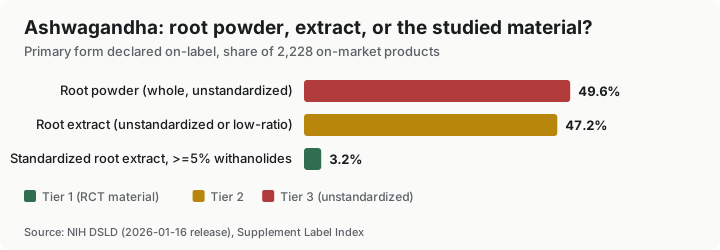
The most-cited ashwagandha trial is a 2012 randomized, double-blind, placebo-controlled study by Chandrasekhar and colleagues in the Indian Journal of Psychological Medicine. Sixty-four adults with chronic stress took 300 mg of a high-concentration, full-spectrum root extract twice daily for 60 days. The treatment group showed a significantly greater reduction in stress-scale scores than placebo (p<0.0001), and serum cortisol fell significantly more as well (p=0.0006). The extract used is commercially known by a branded name, and it is standardized specifically for withanolide content, which is what our reference table’s top tier reflects. A raw root powder or an unstandardized extract has not been tested under the same conditions, so it is not established that it produces the same effect at the same milligram dose.
The trend is moving, slowly, in the right direction
Both compounds are improving year over year, even though the bottom-tier share is still high. Curcumin’s share of products in the lowest tier fell 4.8 percentage points over the most recent year in our data, and ashwagandha’s fell 14.0 points, the largest year-over-year improvement of any compound we track. That is consistent with a market where phytosome and standardized-extract options exist and are slowly gaining shelf space, even if they remain a small minority. It also means a Cheap Form Index snapshot like this one is a moment in time, not a fixed verdict on either ingredient.
Why manufacturers use the cheaper forms
Cost is the obvious reason: raw powders and unstandardized extracts are less expensive to produce than a formulation with a guaranteed, tested specification. But there is a second, more structural reason. Standardized, branded materials such as the ones used in the curcumin and ashwagandha trials above are typically protected by trademark or patent, and a manufacturer that wants to use them pays a licensing premium per kilogram. A company selling a lower-cost product has a real incentive to use the generic material, list “curcumin” or “ashwagandha” on the front of the label, and let the shopper assume it is the same thing the headlines are describing.
This is not necessarily deceptive. Nothing on a typical label claims the product is clinically studied unless it actually uses the studied material, and generic root powder or plain curcuminoids are legitimate products in their own right, just less studied at the doses sold. The problem is that the front label rarely tells you which one you are holding.
Where our own tiering gets uncertain
We hold ourselves to the same standard we’re describing here: cite the material actually used in research, and say plainly when we can’t. Ashwagandha has a third commercial category, standardized to a higher withanolide-glycoside content and typically made from root plus leaf rather than root alone. It carries real supporting trials, but our own citation for its tier is marked provisional pending a fuller literature review, and we say so on its compound page. Similarly, one common ashwagandha extract category has no dedicated bioavailability or efficacy study behind it at all in our reference table; we tier it in the middle by default, not because a study supports it, but because it sits, unstandardized, between raw powder and the guaranteed-content extracts. A tier is our summary of what evidence exists, not a promise that better evidence couldn’t move it.
This is not just a botanical problem
The same gap between “the ingredient” and “the specific form that was studied” shows up across the market, not only in curcumin and ashwagandha. Magnesium, the third-ranked compound on the Cheap Form Index, sells mostly as oxide, the form with the weakest absorption data of the common salts; we covered that in an earlier post. Iodine and zinc show smaller but real versions of the same pattern. If a supplement’s benefit depends on the studied dose reaching your bloodstream, the form on the label is worth as much attention as the amount.
Form isn’t the only gap: dose matters too
Even a product using the right form can fall short on amount. A 2021 meta-analysis of 15 randomized controlled trials for osteoarthritis by Zeng and colleagues in Bioscience Reports covered curcumin doses from 500 mg to 2,000 mg a day. Across 1,473 on-market curcumin products with a declared dose, the median serving supplies just 100 mg, and only the top decile (664 mg or more) starts to approach the bottom of that studied range.
Ashwagandha lines up a little better against its own pivotal trial. The Chandrasekhar study used 600 mg a day, split into two 300 mg doses. That figure sits almost exactly at the 80th percentile of on-market ashwagandha products (250 mg is the median, 600 mg is roughly where the 80th percentile falls), meaning a majority of products declare less per day than the trial used, even before accounting for which form they use. Form and dose are separate checks, and a product needs to clear both to resemble what was actually tested.
Reading the fine print
The clue is almost always in the small type under the ingredient name, not the front-of-bottle marketing:
- For curcumin, look for “Curcumin Phytosome,” “Curcumin Phospholipid Complex,” or a named branded complex, versus plain “Curcuminoids,” “Turmeric Extract,” or “95% Curcuminoids.”
- For ashwagandha, look for a specific withanolide percentage (for example ”>=5% withanolides”) and whether the material is root-only or root-plus-leaf, versus a bare “Ashwagandha Root Powder” or “Ashwagandha Extract” with no percentage given.
- A branded name is a strong signal but not a guarantee. Branded complexes are usually standardized, but check the withanolide or curcuminoid percentage yourself when it is printed, rather than relying on the name alone.
- A higher milligram number does not offset a lower-tier form. A larger dose of an unstandardized extract is still an unstandardized extract; potency, not just quantity, is what the research controlled for.
You can look up the tier and citation for any of the 40 compounds and their forms on their compound pages, for example curcumin and ashwagandha, or see the full ranking on the Cheap Form Index report.
Sources
- Zeng L et al. The efficacy and safety of Curcuma longa extract and curcumin supplements on osteoarthritis: a systematic review and meta-analysis. Biosci Rep 2021;41(6):BSR20210817 (15 RCTs, 1,621 participants). PMID 34017975.
- Cuomo J et al. Comparative absorption of a standardized curcuminoid mixture and its lecithin formulation. J Nat Prod 2011;74(4):664–669. PMID 21413691.
- Chandrasekhar K et al. A prospective, randomized double-blind, placebo-controlled study of safety and efficacy of a high-concentration full-spectrum extract of ashwagandha root in reducing stress and anxiety in adults. Indian J Psychol Med 2012;34(3):255–262. PMID 23439798.
- NIH Dietary Supplement Label Database, January 16, 2026 release; analysis by Supplement Label Index (methodology).
Follow new findings with the Insights RSS feed — it updates each time the label data refreshes.