Half of US supplement brands list one of five states
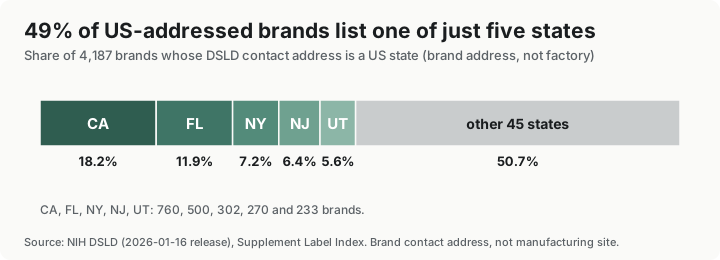
California, Florida, New York, New Jersey and Utah hold 49% of US-addressed brands in DSLD. Utah has about 1% of US residents but 5.6% of brands. These are brand addresses, not factory locations.
By Alykhan Virani · October 2, 2026 · 6 min read · data from the January 16, 2026 DSLD release
Before anything else, the caveat that governs every number below: this is where a brand says it is located, not where its products are made. The address we analyze is the brand’s contact address as entered in the NIH Dietary Supplement Label Database (DSLD). A brand with a Utah address may have its product made by a contract manufacturer in another state or another country. Nothing in this analysis measures manufacturing location, ingredient origin, or quality.
With that said, brand addresses still show something real: where the businesses that put their names on supplement labels are concentrated. It’s more lopsided than most people expect.
What the data does and doesn’t cover
DSLD lists 5,801 brands. Of those, 4,369 (75.3%) have a state value in their contact address, and only 1,092 (18.8%) have anything in the country field. Both fields are free text typed by whoever submitted the label, so the raw data contains “CA”, “California”, “Ca.” and “ca” as separate entries, plus Canadian provinces and foreign cities in the state field and ZIP codes in the country field. We merged spelling variants only when a value matched a US state name or postal code exactly, and left the rest unclassified rather than guess.
That leaves 4,187 brands with a US state address. For product counts we use on-market products tied to those brands: 80,814 of the 121,959 on-market products in the database. Everything below is that slice, not the whole market.
Five states hold half of the brands
California has 760 brands (18.2%), Florida 500 (11.9%), New York 302 (7.2%), New Jersey 270 (6.4%) and Utah 233 (5.6%): together 49.3%. The top ten states account for 67.3%.
Some of that is just population. California has about 12.0% of US residents and 18.2% of brands, which is a modest tilt. Texas runs the other way: 8.8% of residents but 5.2% of brands (217). The population figures come from the 2020 Census.
The per-capita picture is stranger
Scale each state’s brand count by its population and the ranking changes sharply. The US-wide figure is 12.7 brands per million residents. Utah has 71, from 233 brands in a state with about 1.0% of the population. Nevada is at 45 and New Jersey at 29. California, the largest by count, is at 19.
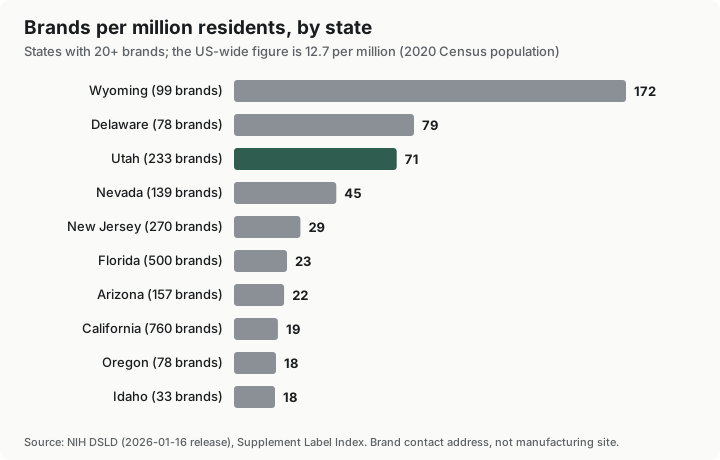
The outliers are Wyoming (99 brands, 172 per million) and Delaware (78 brands, 79). We can’t say from the data why. A listed address might be a headquarters, a warehouse, or a mailing address, and DSLD doesn’t tell them apart. It’s a reason not to read a brand’s state as a statement about where the company’s staff or equipment actually are. Wyoming’s 99 brands also account for just 594 on-market products, about six each.
Brand counts and product counts tell different stories
Counting products instead of brands reorders the list. California still leads, with 13,080 products (16.2%), but New York is second at 7,639 despite having fewer brands than Florida. Florida has 500 brands but 5,920 products. Hawaii is an extreme case: 17 brands list 3,087 products, about 182 each, enough to rank tenth among states by products. North Dakota’s 19 brands carry 1,005.
The pattern is a long tail: many small brands with a handful of products, and a few large catalogs concentrated in a few addresses. A state’s rank by brands says little about how much of the shelf it represents. This is also where private-label manufacturing complicates the picture, since one contract manufacturer can supply brands in many states, which we looked at in our post on formula twins.
Outside the US: Canada stands out
Among the 1,092 brands with a country value, 869 (79.6%) name the United States (any spelling), 49 enter a string of digits that looks like a US ZIP code, and 139 (12.7%) name a clearly identifiable country outside the US. The rest are unclassifiable. The country field is empty for most brands, and we don’t know whether the brands that fill it in resemble the ones that don’t, so treat these as shares of a partial sample.
Canada leads the named countries with 52 brands, then the United Kingdom with 31. India, New Zealand and Mexico have 7 each, and Germany 6.
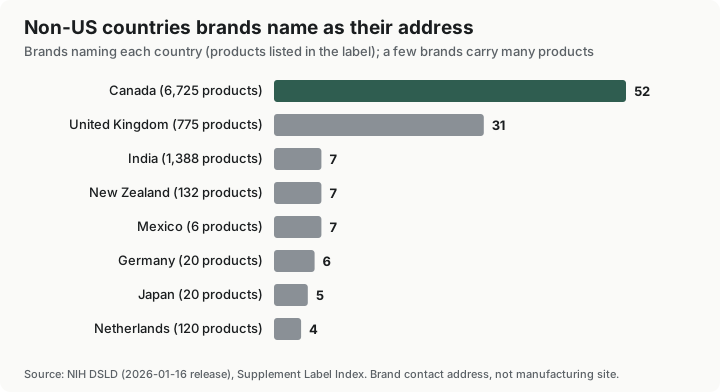
Product counts differ from brand counts here too. Canada is 4.8% of country-field brands but lists 6,725 of 31,255 products with a country value (21.5%), about 129 per brand versus about 24 for US-named brands. India has 7 brands and 1,388 products, and a single brand naming Luxembourg lists 468. The state field shows the same thing for Canada: Canadian provinces appear there for 80 brands and 7,625 products, and Ontario’s 7,251 alone would rank third if counted alongside the US states, behind California and New York and ahead of New Jersey. In every case a few large catalogs drive the totals.
What the rules say about addresses and origin
Three federal rules explain why a brand’s address isn’t an origin claim.
The label address isn’t necessarily the factory. FDA’s labeling regulation requires a packaged food label to state the name and place of business of the “manufacturer, packer, or distributor,” and FDA’s dietary supplement labeling guide lists this among the required statements on supplement labels. When the named business didn’t manufacture the product, the name must be qualified with wording such as “Manufactured for” or “Distributed by.” The guide also notes that a principal place of business may be listed in place of the actual address.
“Made in USA” is a separate, stricter claim. Under the FTC’s rule, an unqualified “Made in USA” claim requires that final assembly or processing happen in the United States, that all significant processing happen there, and that all or virtually all ingredients be made and sourced there. A US address on a label meets none of these tests by itself, and this analysis doesn’t evaluate such claims.
FDA’s facility registration covers factories, not brands. Under the Bioterrorism Act, owners or operators of domestic or foreign facilities that manufacture, process, pack or hold food for US consumption must register, and the regulation’s definition of food includes dietary supplements. Foreign facilities must also give the name and address of a US agent. That registry describes facilities; we don’t use it, and it isn’t what DSLD’s brand addresses record.
What to check when a label mentions a place
- Read the qualifying phrase. “Distributed by” or “Manufactured for” before an address means the named business may not have made the product.
- A US address isn’t a “Made in USA” claim. Only an explicit claim, which has its own FTC standard, says anything about where a product was made.
- A brand’s state tells you little about the product. It tells you where a business lists its address, which can be an office, a warehouse or a mailing address.
- Use geography for market structure, not for ranking brands. We don’t score or rate brands, and a location in a given place says nothing about quality in either direction.
Sources
- NIH Dietary Supplement Label Database, January 16, 2026 release; analysis by Supplement Label Index (report, methodology). State and country spelling variants merged by us; unmatched values left unclassified.
- U.S. Census Bureau. 2020 Census apportionment, Table 2: Resident population for the 50 states, the District of Columbia, and Puerto Rico (resident population, April 1, 2020).
- 21 CFR 101.5. Food labeling: Name and place of business of manufacturer, packer, or distributor.
- U.S. Food and Drug Administration. Dietary Supplement Labeling Guide: Chapter I. General Dietary Supplement Labeling.
- 16 CFR 323.2. Made in USA Labeling Rule: Unqualified claims (Federal Trade Commission).
- 21 CFR 1.225, 1.225 (who must register), 1.227 (definitions of food and foreign facility, including dietary supplements) and 1.232 (U.S. agent for foreign facilities).
- U.S. Food and Drug Administration. Registration of Food Facilities and Other Submissions (Bioterrorism Act background).
- U.S. Food and Drug Administration. FDA's Regulation of Dietary Supplements with Dr. Cara Welch (YouTube).
Follow new findings with the Insights RSS feed — it updates each time the label data refreshes.