Restricted elsewhere, still on US supplement labels: titanium dioxide and the synthetic dyes
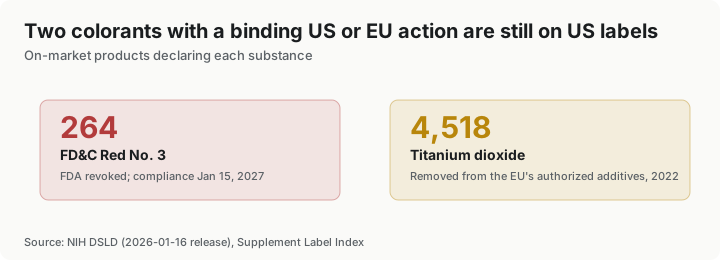
4,518 US supplements list titanium dioxide, removed from EU food additives in 2022; 264 still list FD&C Red No. 3, revoked by FDA itself. What's actually binding, and what isn't.
By Alykhan Virani · September 22, 2026 · 6 min read · data from the January 16, 2026 DSLD release
Some ingredients sold in US supplements today are already restricted or banned somewhere else, sometimes by the FDA’s own order. That doesn’t mean every affected product is doing something wrong; compliance deadlines exist for a reason, and not every foreign or state action actually reaches dietary supplements. But it does mean the ingredient list on the bottle in your cabinet may include something a regulator has already moved against. We checked every on-market product in the NIH Dietary Supplement Label Database (DSLD) against ten separate regulatory actions to see exactly where things stand.
The two that clearly apply to supplements
Most of the actions we tracked are warning labels, voluntary requests, or state food laws whose reach into dietary supplements specifically is unclear or contested. Only two are both legally binding and clearly stated to cover supplements.
Titanium dioxide was removed from the European Union’s list of authorized food additives by Commission Regulation (EU) 2022/63, effective across the EU from August 2022. The European Commission’s own announcement lists food supplements among the products affected. 4,518 on-market US products, 3.7% of the entire on-market catalog, still list titanium dioxide.
FD&C Red No. 3 was revoked by the FDA itself. In January 2025, the agency repealed the color-additive listings that permitted Red No. 3 in food, “including dietary supplements,” and in ingested drugs, citing cancer findings in laboratory rats under the Delaney Clause. Manufacturers have until January 15, 2027 to comply. 264 on-market products currently list it.
Both numbers will fall as the FDA’s compliance deadline approaches and as EU-facing brands reformulate, and the DSLD reflects only what’s currently on file, so some of these 264 Red No. 3 products may already be reformulating even though the old label is still in the database.
Titanium dioxide kept showing up after the EU acted
Titanium dioxide is the most common of the substances we checked, used to whiten tablet and capsule coatings. Its EU removal took effect in 2022, but that clearly did not stop new US products from launching with it.
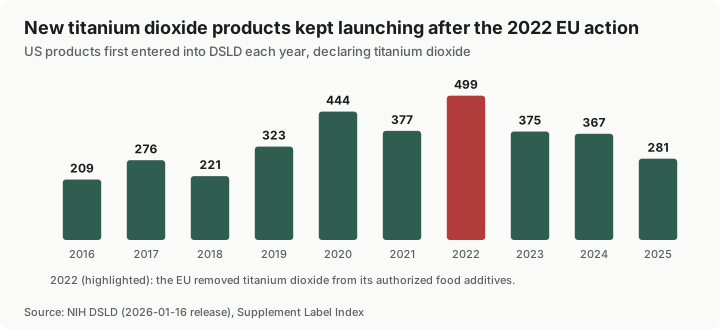
New titanium-dioxide-declaring products actually peaked in 2022, the same year the EU action took effect, and 281 more were still entering the database in 2025. Since the US market and the EU market run under separate rules, a US-only brand has no direct compliance obligation from the EU’s move; the pattern here likely reflects that titanium dioxide remains fully permitted for supplement use in the United States, not that anyone is defying a rule that applies to them.
The synthetic dyes: mostly requests and warnings, not bans
Six other substances we tracked are FD&C color additives, the “Red 40,” “Yellow 5,” “Blue 1” family of synthetic dyes. None of the actions touching them in our data currently bind US supplement makers.
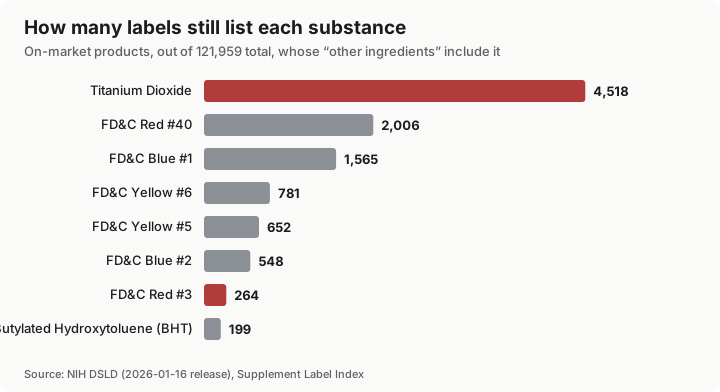
In April 2025, HHS and the FDA announced they would work with industry toward a voluntary phase-out of six petroleum-based dyes from the food supply by the end of 2026. It’s a real, publicly stated goal, but nothing binding was issued alongside it, and the dyes’ existing federal authorizations, including for Red 40 specifically, still permit their use. Separately, the EU has required a hyperactivity warning label on foods containing three of these dyes since 2010, under Regulation (EC) No 1333/2008; whether that specific requirement extends to food supplements under EU law is not settled in the text of the rule itself. A scattering of state laws, in California, West Virginia and Texas, also touch some of these substances, but each one either doesn’t mention dietary supplements, has unclear coverage, or explicitly exempts them, as Texas’s warning-label law does.
Preservatives caught up in the same laws
Two older preservatives show up in the same state bills as the dyes. Butylated hydroxytoluene (BHT), an antioxidant used to keep oils and fats in a formula from going rancid, appears on 199 on-market products and is named in Texas’s SB 25, a warning-label law that explicitly exempts dietary supplements. Propylparaben, a preservative against bacterial and fungal growth, appears on 78 products and is named in both California’s AB 418 (a 2027 food ban whose text never mentions supplements) and West Virginia’s HB 2354 (a 2028 food law facing a reported federal injunction against enforcement). None of these three laws currently stops a supplement from using these ingredients; they are food-focused statutes whose authors did not clearly turn their attention to the supplement aisle.
Why “restricted somewhere” isn’t the same as “banned here”
It’s tempting to read any foreign restriction as proof an ingredient is unsafe, but the reality is more mixed. Regulatory systems differ in what evidence they require and how they weigh it: the EU’s additive approval process places the burden on the manufacturer to demonstrate safety before authorization, and can withdraw an approval when new data or a revised risk assessment comes in, even without a specific safety incident. The US system, by contrast, presumes many long-used additives are “generally recognized as safe” unless a challenge succeeds in overturning that status, a higher and slower bar to clear. The result is that the EU has removed dozens of additives the FDA has not acted on, without that gap always reflecting a genuine disagreement about risk versus caution. That gap in stringency is a policy choice each jurisdiction makes, not a hidden consensus that one side is right; a substance can be removed from one system for exceeding its (lower) tolerance for uncertainty while remaining well within the other system’s threshold for acceptable risk.
The FDA’s Red No. 3 decision is a useful contrast case precisely because it isn’t like the others in this list: it is a specific, binding US action, backed by the agency’s own finding, that names dietary supplements directly. It is the clearest example in our data of a substance where “restricted elsewhere” has become “restricted here too,” and it shows that the gap can close, even if it usually closes slowly, on a timeline measured in years.
What this does and doesn’t tell you
None of this means a product containing titanium dioxide or a synthetic dye is unsafe at the doses used in supplements; regulatory status and safety evidence are related but distinct questions, and an ingredient can be legal, common, and still debated. What the data does tell you is where the actual legal ground stands for each substance, separate from headlines that sometimes conflate “the EU doesn’t allow this” with “this has been proven harmful.” A few practical takeaways:
- Check ingredient lists, not just front-of-label claims. Titanium dioxide is typically used in tablet or capsule coatings and rarely mentioned outside the ingredient panel.
- A compliance deadline is not a recall. The Red No. 3 order gives manufacturers until January 2027; a product on shelves today with Red No. 3 is not automatically noncompliant with anything yet.
- “Restricted in the EU” needs the specific rule checked. Some EU actions clearly reach supplements; others are food-only or ambiguous, and conflating them overstates the case.
- Kids’ products deserve extra attention here. Synthetic dyes and titanium dioxide both turn up in products marketed to children; we track that overlap in our Kids’ Supplements report.
See the full substance-by-substance breakdown, including every action’s citation and its stated coverage of supplements, on the Restricted Elsewhere report.
Sources
- Commission Regulation (EU) 2022/63, removing titanium dioxide (E171) from the EU's authorized food additives. EUR-Lex; European Commission announcement.
- U.S. Food and Drug Administration. Color Additive Petition from Center for Science in the Public Interest, et al.: Request To Revoke Color Additive Listing for Use of FD&C Red No. 3 in Food and Ingested Drugs (FR Doc. 2025-00830). Federal Register.
- HHS, FDA. HHS, FDA to Phase Out Petroleum-Based Synthetic Dyes in Nation's Food Supply (April 2025).
- Regulation (EC) No 1333/2008, Article 24 and Annex V (mandatory warning label for three colors). EUR-Lex.
- NIH Dietary Supplement Label Database, January 16, 2026 release; analysis by Supplement Label Index (methodology; full citations for every action on the Restricted Elsewhere report).
Follow new findings with the Insights RSS feed — it updates each time the label data refreshes.